
Paint Colors & LRV Explained: A Homeowner’s Guide
Light Reflectance Value. What is it? How does it relate to paint colors? Why should we care? And WHY has it suddenly become a buzzword in the paint color world? Because someone realized it was kind of a big deal – that someone was me.
Seriously, I’m not tootin’ my own horn, or gassy in general; however, early in my paint studies, I realized how massively important LRV is to the paint color world, and wondered why NO ONE was really talking about it.
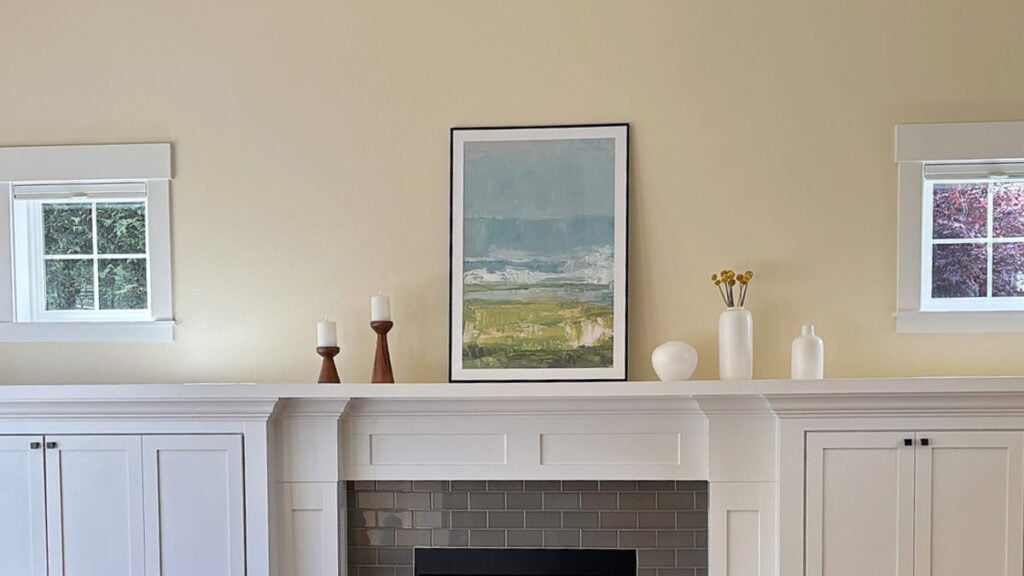
So now we are.
LRV stands for Light Reflectance Value.
And let me tell you, it took 14 hours, 3 bottles of wine, and 24+ years of experience to research and write this article. And I’m not even remotely scientifically inclined (more artsy-fartsy inclined). However, as an integral part of the Kylie M. Color System, which focuses on ‘user-friendly’ color advice and teachings, this stuff matters… a lot.
So, let’s grab a glass and settle down for a bit of a read – just because I’m keeping it simple doesn’t mean I’m keeping it SHORT!
WHAT DOES LIGHT REFLECTANCE VALUE (LRV) MEAN?
Light Reflectance Value (as it relates to paint colors) is a number that every paint color has. This number tells you (on a scale of 0-100) how much visible light a paint color reflects or absorbs when illuminated.
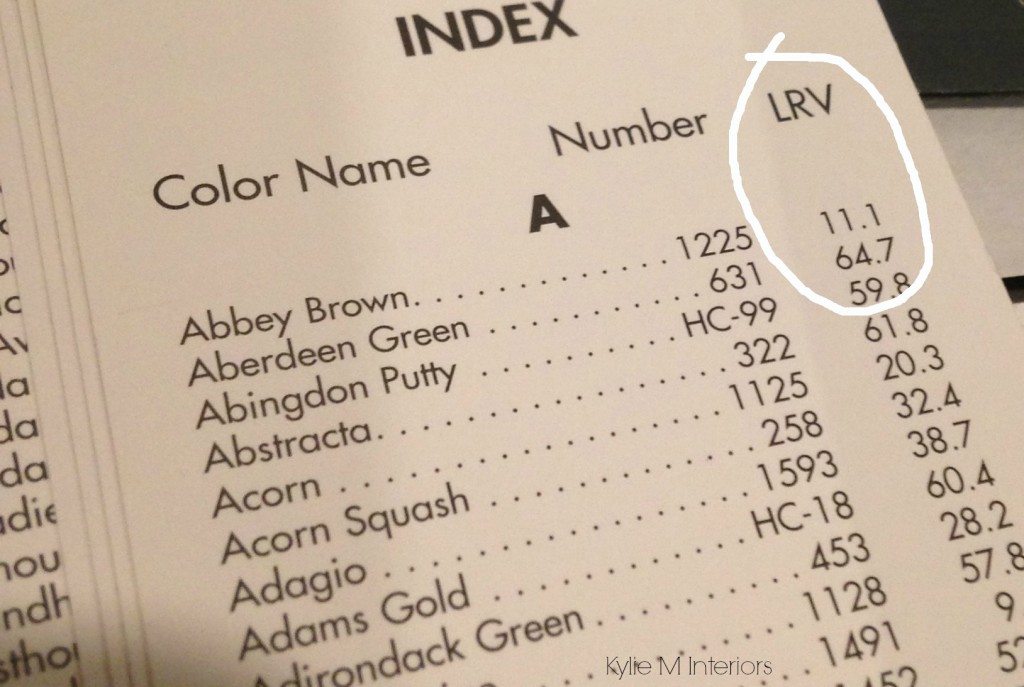
The higher a paint color’s LRV is, the more light it reflects. The lower a paint color’s LRV is, the less light it reflects and the more it absorbs.
However, sometimes facts don’t really ‘hit ye ole noggin’ in a way that makes sense. So, with the above in mind, and tweaking it to be a bit more usable for the average homeowner…
WHAT DOES LRV MEAN FOR PAINT COLORS?
The idea of ‘a paint color reflecting light or not’ doesn’t really TELL us a lot. Instead, let’s consider it a different way…
A paint color’s LRV indicates its potential DEPTH (i.e., white, light, medium, dark), based on how much light it reflects. From there, it’s on the room to PROVIDE the light.
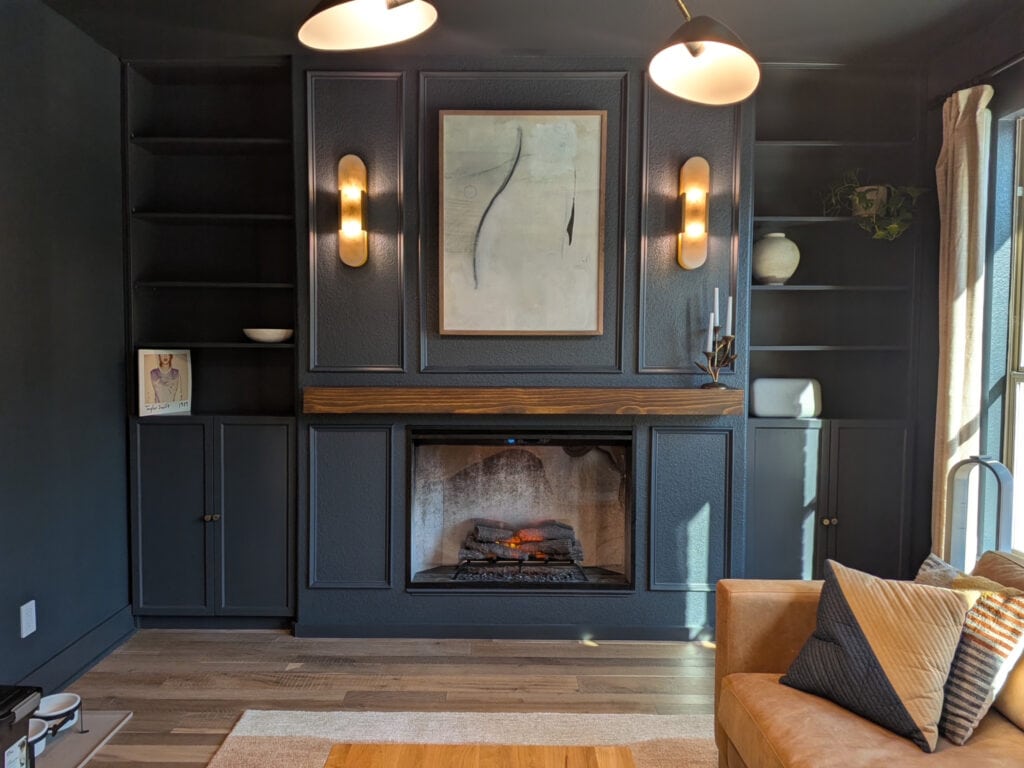
For example, the above paint color is Sherwin Williams Cyberspace, which has an LRV of 6. This means it’s a dark paint color, as this low LRV reflects very little light. Now, compare the left side of the fireplace to the right side.
A paint color can only reflect light if it’s GIVEN light.
On the other hand, this living room is painted Sherwin Williams Pure White, which has an LRV of 84, which means it’s a light paint color that reflects a lot of light…
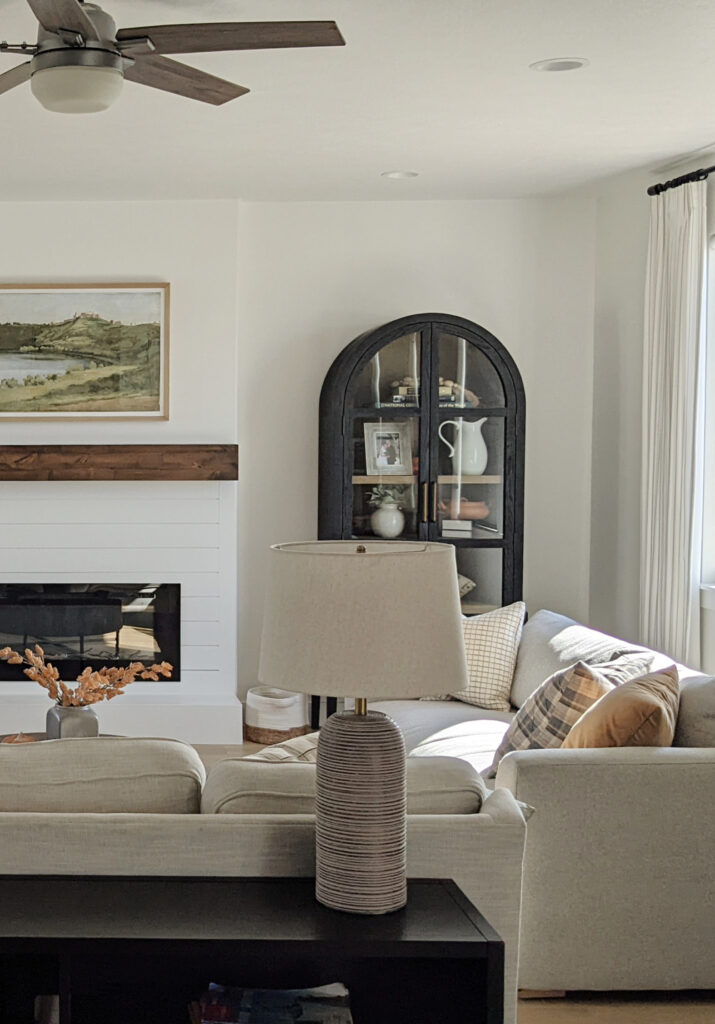
However, regardless of a paint color’s LRV, it can only reflect the light it receives.
THINK IN PERCENTAGES
Think of a paint color’s LRV as a percentage of light it reflects. For example, Sherwin Williams Redend Point (below) has an LRV of 30, which means it reflects approximately 30% of any light IT’S GIVEN…
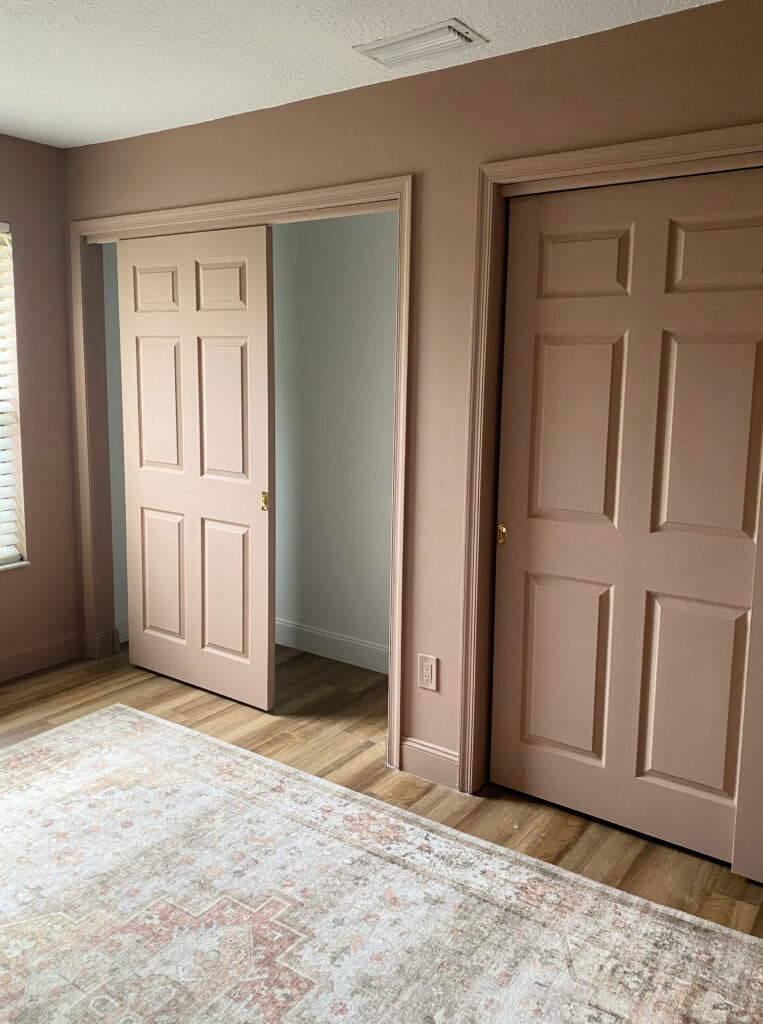
No matter how bright or dark your room is, a paint color’s LRV number never changes. Its APPEARANCE will only change based on how much light you GIVE your paint color to reflect.
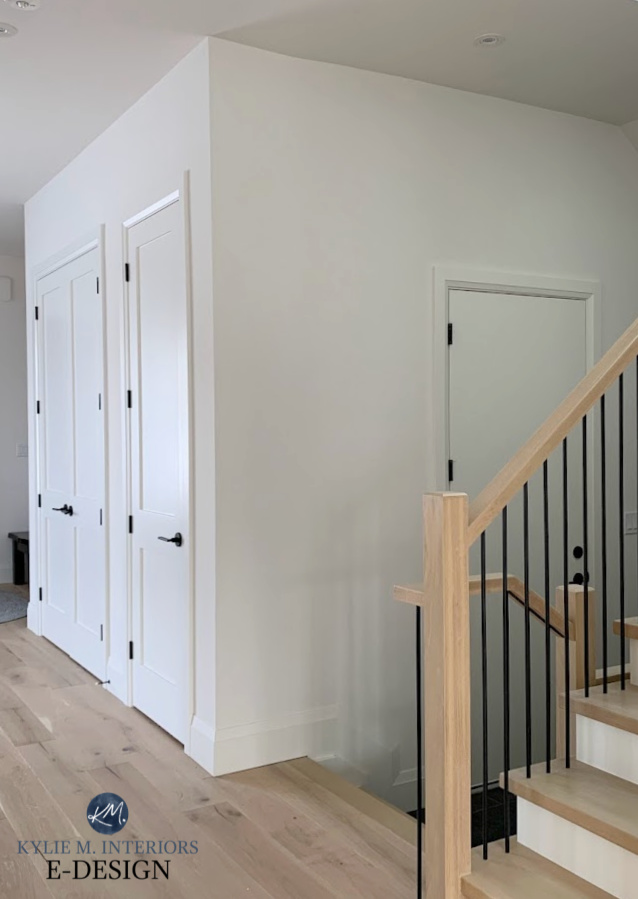
Benjamin Moore White Dove (below) is a white paint with an LRV of 83.16. This higher LRV reflects a lot of light, as shown on the left side of this photo, but it falls a bit flat in areas that don’t have enough light for it to reflect…
The Best Paint Colors for Light Wood Finishes
The above is a great example of a color with a reasonably high LRV (83) that uses the natural light it’s given and bounces it around (or not). It’s still in the white range, but without a light source, it won’t do its best work.
Colors need LIGHT to come to LIFE!
In other words, don’t expect a color to be a miracle worker if you don’t have enough natural light or interior lighting.
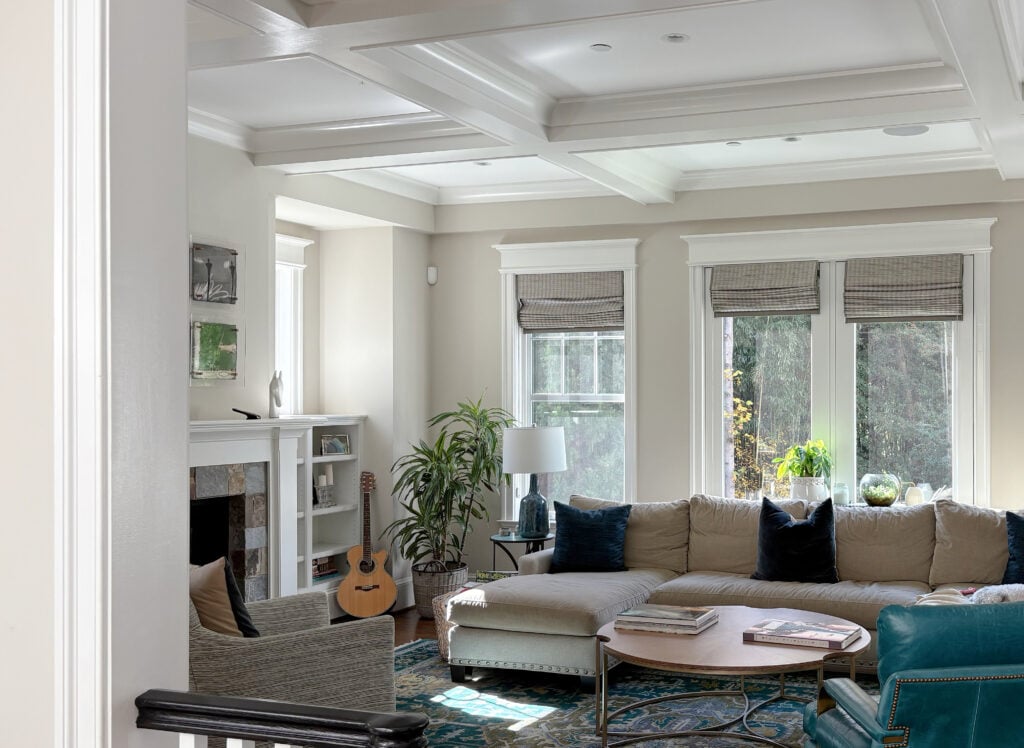
Now, those are the bare bones. Let’s get to how the Kylie M Color System groups colors. Remember, you can narrow down your color choices considerably by figuring out which RANGE you want your color to be in!
Before we get into some fun examples and more guts, you need to know where to find this magical lil’ number…
WHERE DO YOU FIND A PAINT COLOR’S LRV NUMBER?
Given how important LRV is to the average paint buyer, I’m surprised some paint companies haven’t made it easier to find.
Here’s where you’ll find the LRVs for a few popular paint brands (or ask a store employee)…
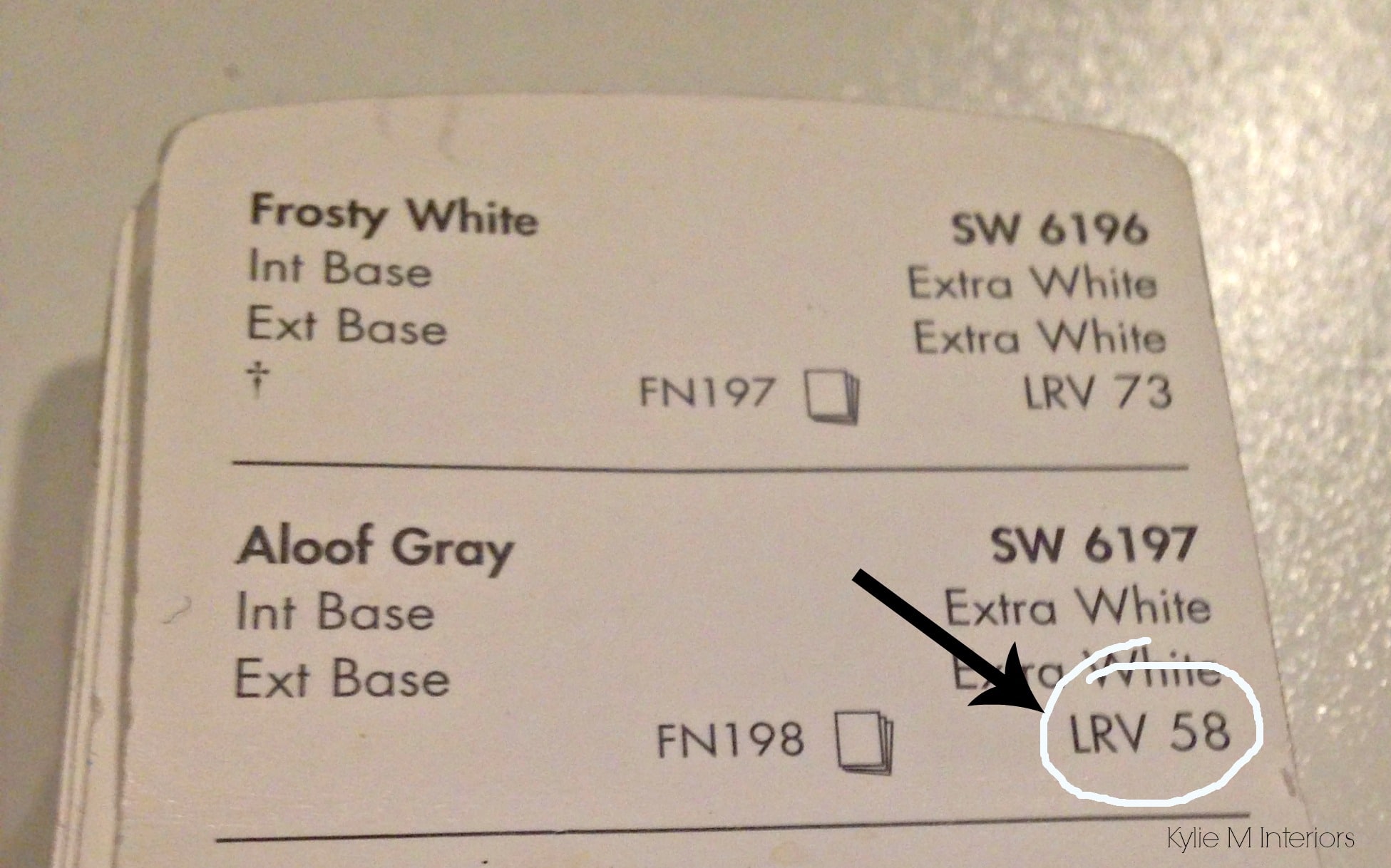
- SHERWIN WILLIAMS LRVs: On the back of each color in the fan deck or on the back of each independent color chip. They also have it listed in the fan deck index and online – thank you, Sherwin Williams!
- BENJAMIN MOORE’S LRVs: On the Benjamin Moore website (on that specific color’s page), as well as in the fan deck index.
- FARROW & BALL’S LRVs: They don’t make it easy; you’ll want to write customer service – and good luck with that – thanks for comin’ out F&B
- VALSPAR’S LRVs: Fan deck index
- BEHR’S LRVs: Fan deck index
Here’s what it looks like on the back of the Sherwin William’s color strip (the long row of colors in the fan deck OR on the small samples found in-store)…
And in the index of the Benjamin Moore fan deck…
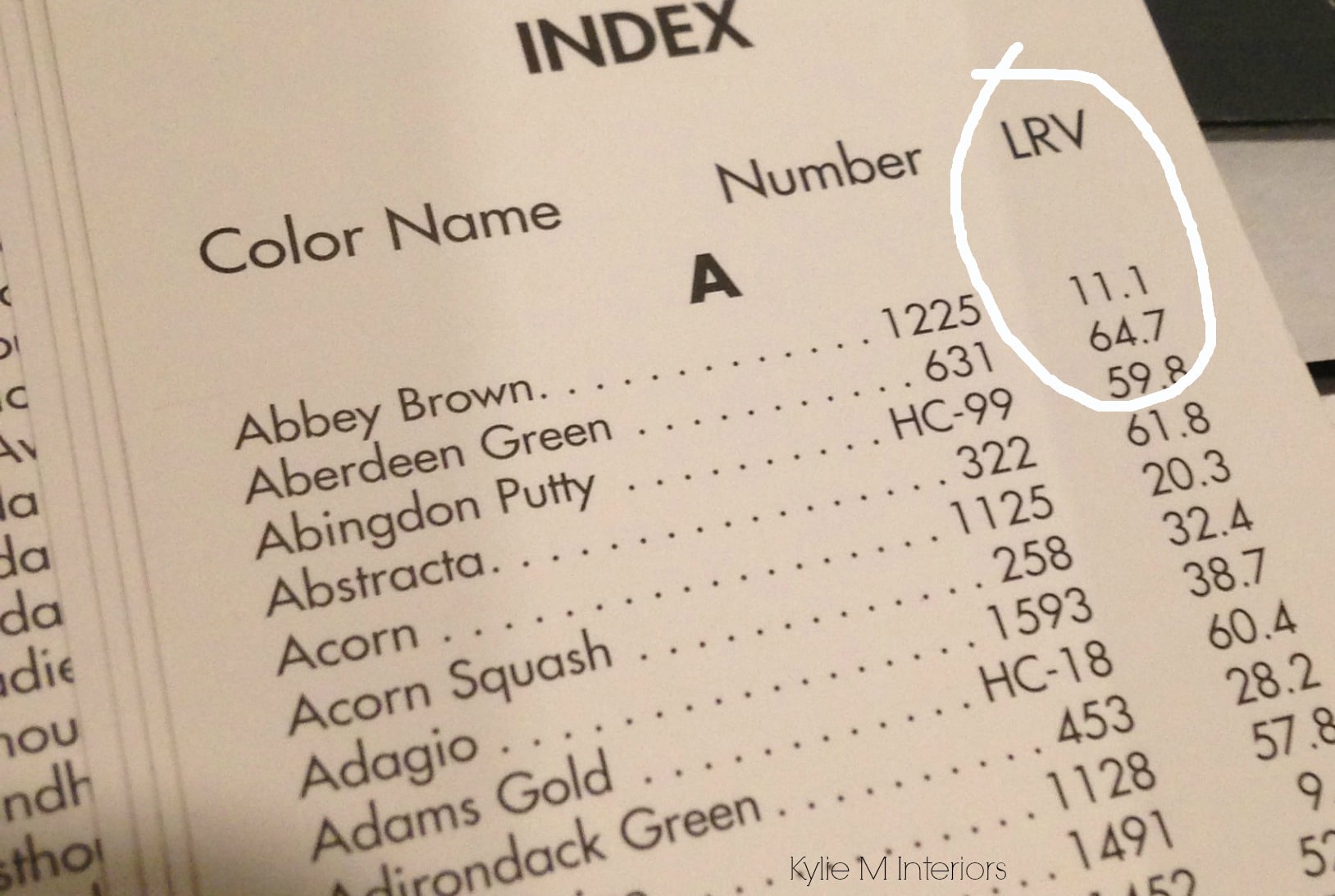
Wine break. Glug glug glug, I mean sip sip sip. And no, I don’t drink THAT much, it’s just a hobby.
Now, let’s discuss the actual LRV ranges. Again, this is not scientific – there IS no scientific break between paint color depths; it’s experience-based (being one of the leading color experts in North America, that carries some serious weight – a lot of it in my rear end, which is one of my redeeming features, along with my charm and extensive paint color knowledge).
THE ‘USABLE’ LRV SCALE (for real homes & real people)
While the scale technically goes to 100, in terms of the non-scientific (residential/commercial) paint world…
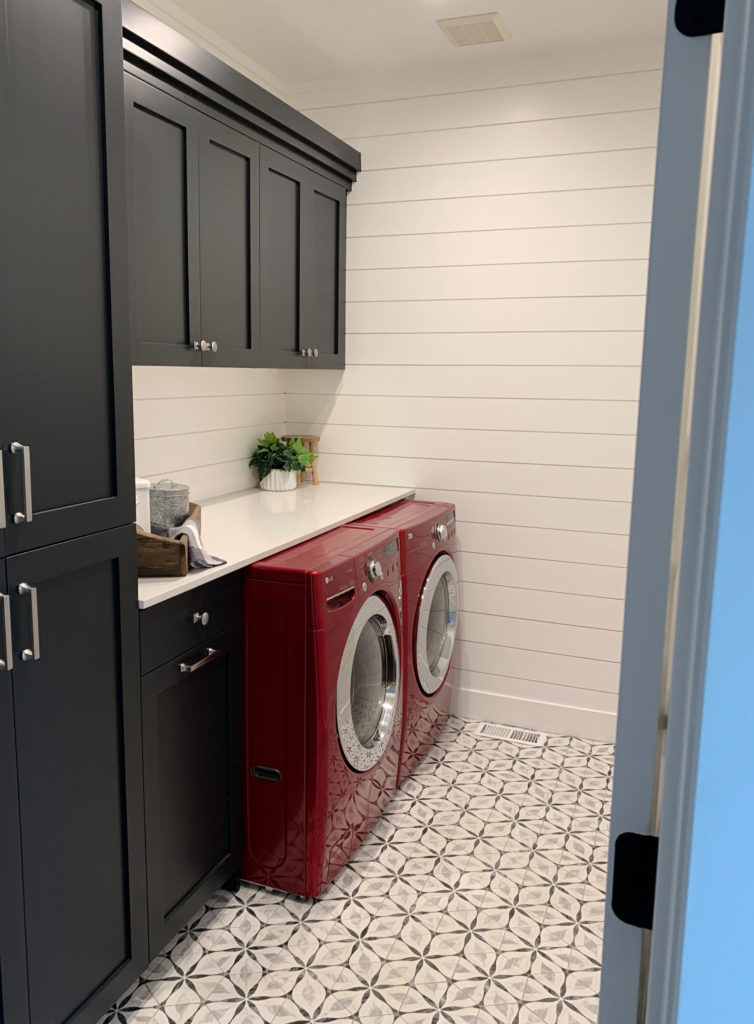
- White only goes as high as 94 – that’s the whitest white available.
- Black goes down to 2 – that’s the darkest color available.
My client’s laundry room (below) is a great example of these extremes…
Remember, you don’t need to memorize ALL of this (unless you’re a glutton for punishment). Use the info that applies to the color/color range(s) you’re exploring to find your best shade!
These numbers will give you a good idea of a color’s depth (how light or dark it is). The ranges below are approximate (two to three points or so) as the lines are blurry. Or maybe that’s because I’ve had two glasses of wine.
LRV vs. COLOR DEPTH
Others might group depths differently. However, 12,000+ consultations (in-home and online), 24+ years of research, plus 600+ blog posts have led me to conclude the following…
2-10 = DARK PAINT COLORS
10-20 = MEDIUM-DARK PAINT COLORS
20-40 = MEDIUM-DEPTH PAINT COLORS
40-55 = LIGHT-MEDIUM COLORS
55-72 = LIGHT COLORS
73-81 = OFF-WHITE COLORS
82-94 = WHITE PAINT COLORS OR VERY LIGHT, HIGHER CHROMA COLORS*
What’s with that last range? A paint color’s LRV doesn’t tell you how COLORFUL or how much CHROMA it has – it just tells you how much light it does/doesn’t reflect. Some colors have high LRVs and reflect a lot of light, but still have a lot of COLOR (chroma). For example, a super light yellow could have an LRV of 88, but not be white.
MOVING ALONG!
Check out this cute bathroom…
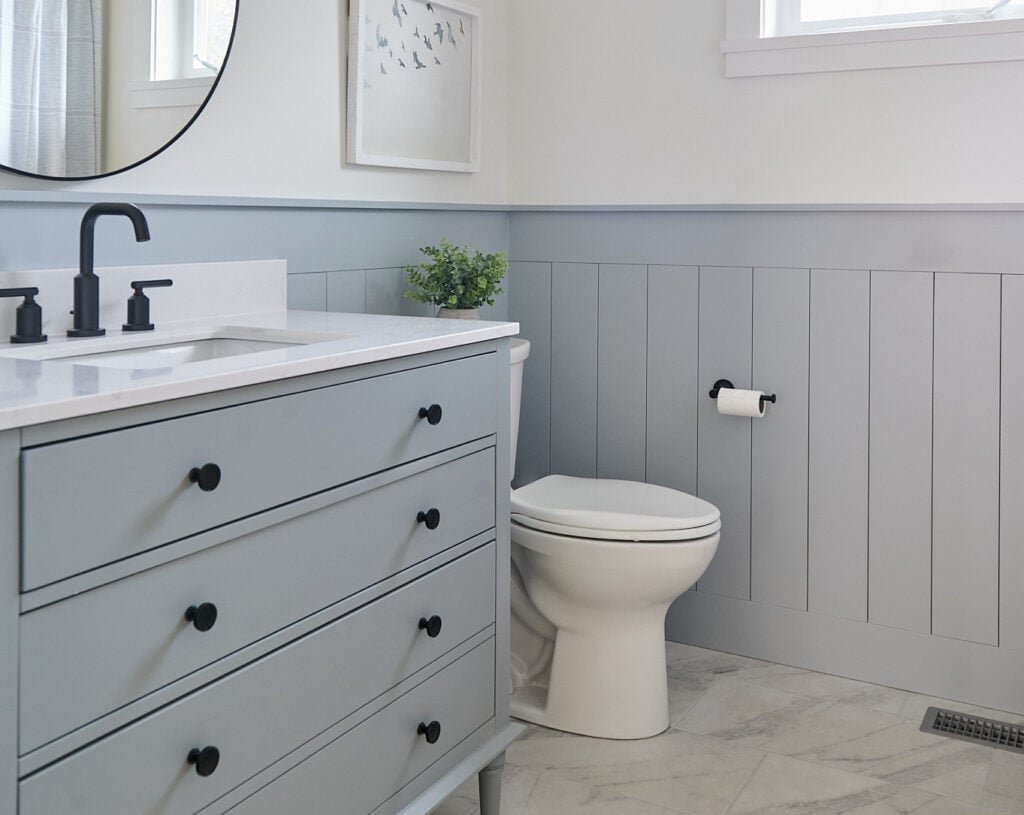
- Benjamin Moore White Dove is on the walls, trims, and ceiling. Its LRV is 83.16, which, along with its low degree of color (chroma), makes it a white.
- Sherwin Williams Network Gray is on the lower walls and vanity. Its LRV is 37, which means it falls in the medium range and reflects less light.
- The difference you see in depth between these two colors is represented by their higher vs. lower LRV numbers—cool, eh?
Now, check out Sherwin Williams Rock Bottom. It has an LRV of 7, meaning it’s a DARK paint color and reflects very little light.

The Best Medium to Dark Green Paint Colors
99.5% of the photos in my blog are of REAL HOMES from my Online Color Consulting clients, readers, and friends. While not always magazine-perfect, they’re packed with ideas and proven color choices to help you create a home you’ll love.
Now, let’s spend a little quality time with each range to see how it might work for you and your home.
WHITE PAINT COLORS & LRV
APPROX. 82+
White paint colors have the highest Light Reflectance Value (LRV) and reflect the most light. The range is from 82 to 94, knowing we don’t have access to whites above 94.
On a side note, just because a color has the word ‘WHITE’ in its name (or gray, or beige, or whatever), doesn’t mean it’s white #neverjudgeacolororawinebyitsname
For example, let’s say you’re trying to find the perfect white paint color for your trims, walls, or cabinets, but you’re comparing several and can’t tell which is lighter. Look at their LRVs, and you’ll know EXACTLY which is the brightest white. From there, compare undertones to see which settles best.

Sherwin Williams Pure White LRV 84, is a white paint color | Sherwin Williams Sensible Hue LRV 46, is in the light-medium range. The shift in depth you see represents the difference between these 2 numbers.
A FUN LITTLE EXAMPLE…
Look at these white paint color samples and decide which one is the WHITEST (do this before you keep reading)…

I mean, it doesn’t take a rocket scientist to see it ain’t the bottom one. However, the other 3 are all contenders.
Now, rather than eyeballin’ it, let’s look at their LRVs to see where they stand…
- TOP: Sherwin Williams High Reflective White LRV 93
- 2ND DOWN: Benjamin Moore Super White LRV 87.36
- 3RD DOWN: Benjamin Moore Chantilly Lace LRV 90.04
- BOTTOM: Benjamin Moore Decorator’s White LRV 82.68
Which color is the WHITEST based on LRV and lack of color/chroma? The top sample, Sherwin Williams High Reflective White.
Which color is the least bright? Benjamin Moore Decorator’s White.
Crazy, eh? The shift in these numbers might not seem huge, but on a large scale, you see these LRVs come into play – when there’s more wall space for the color to come to life.
Is White Still Trendy on Walls, Cabinets, & Exteriors?
WHY DOES WHITE OR OFF-WHITE LOOK DINGY IN MY ROOM?
If you choose a paint color with a higher LRV, hoping to make your room look lighter and brighter, but it contains too much gray, it may not fix your problem. Here are some reasons your white or off-white looks dirty…
- Your pairing it with a cleaner shade of white (e.g., a white subway tile/outlet cover/fridge/etc.) or a cleaner, more colorful paint color.
- It has too much gray in its blend and not enough color – that said, when it comes to warm whites, I’ve found many homeowners to be sensitive to too much color (in the form of yellow).
- You don’t have good natural light, interior lighting, or chose the wrong white for your room’s exposure. Make sure your room has enough lumens to be well-lit, and play with your bulb’s Kelvin to change the look of your white paint color.
At this point, it’s not about the LRV; you chose a grayish color that’s naturally a bit dingy.
In the next photo, you’ll see Benjamin Moore’s White Dove, one of the most popular shades of white (LRV 83). Notice how it appears on the upper part of the walls compared to the wee small areas that get natural light – some might call this effect dingy…

The cabinets are Benjamin Moore Chantilly Lace (LRV 90.04).
Personally, I think it has a pretty softness, but if you expect more from your white, you might want to add more color/less gray or look at a brighter white like Chantilly Lace (on the cabinet). That said, Chantilly Lace is receiving a more direct hit of light than White Dove, and its runnin’ with it.
Many of the most popular warm whites can look a bit dirty or dingy in a darkish space because their warmth is subtle and grounded by a gray base (lower chromaticity).

A SUMMARY OF WHITE PAINT COLORS
- The LRVs of white paint colors range from approximately 82 to 94.
- White paint colors don’t just reflect light; whites with less ‘color’ or undertone will reflect the color of the light they’re exposed to. For example, grass or trees outside your window can show up on your walls.
- Just because a color is in the white range doesn’t mean it won’t have undertones—learn about undertones. The most common undertone in white is yellow, since the most popular warm white paint colors are made with it.
OFF-WHITE PAINT COLORS & LRV
APPROX. 73-81
Off-white paint colors have LRVs between 73 and 81. The closer a paint color’s LRV gets to 82, the whiter it appears (with exceptions for colors with a lot of color/chroma, like a super bright, light yellow).
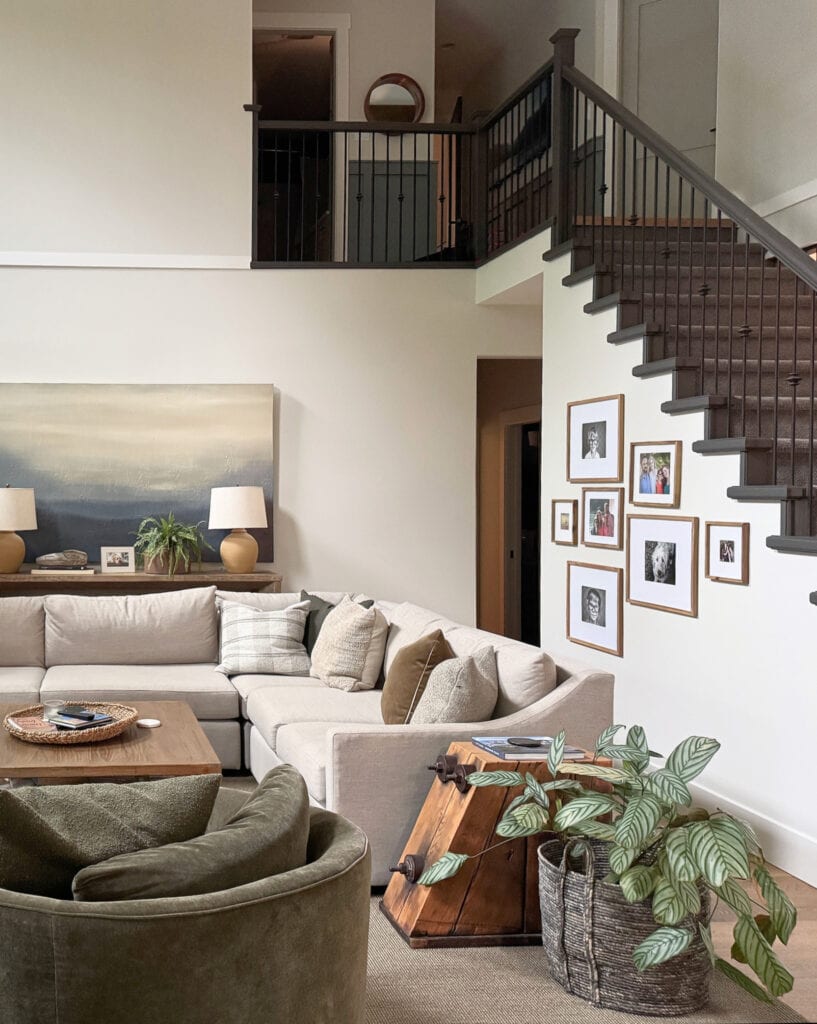
- Off-white paint colors are lower-contrast with white trim
- If you have wood trim, off-white paint colors offer a higher-contrast look
- Off-white paint colors can be neutral or more colorful
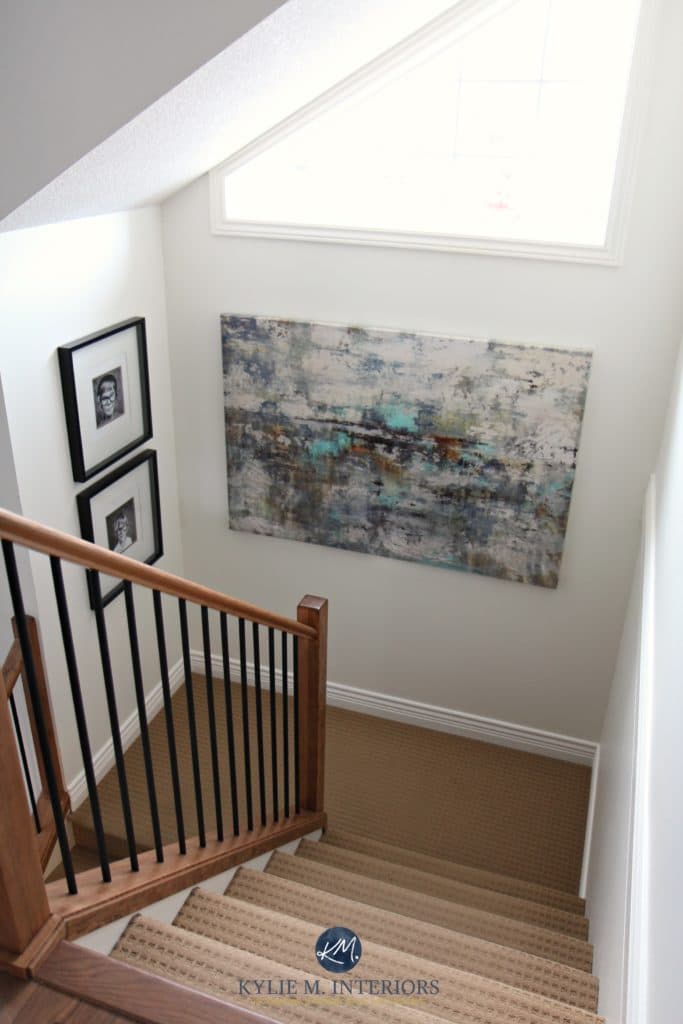
For example, Sherwin William’s Creamy has an LRV of 81—this LRV puts it on the edge of the white range, making it open to perception. In this staircase (below), Creamy looks warm and white, thanks to the natural light from the northeast-facing window.
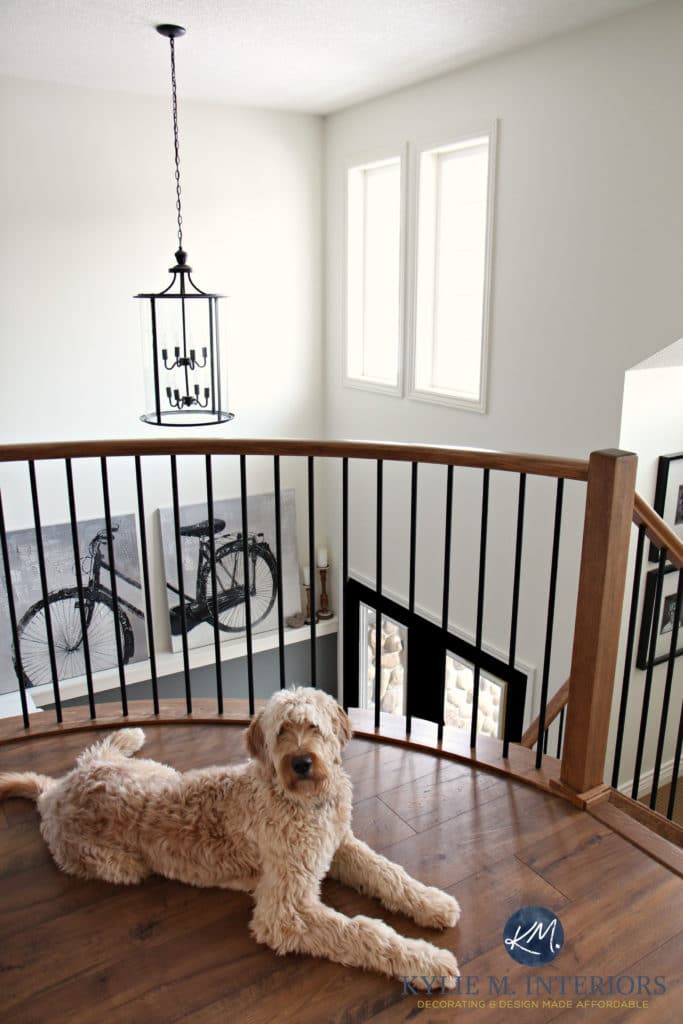
Say hi to Doug – a Golden Doodle/Muppet.
However, notice how different Creamy looks down near the carpet/landing on the same staircase.
Paint Colors to Update a Beige Home
In the above photo, Creamy looks less like a warm white and more like an off-white (which it is). It also looks a bit dingy/dirtier.
Why?
- Because it doesn’t receive as much natural light to reflect, it looks a bit dingy. This is also because it doesn’t have a strong yellow hue.
- It’s depth is a bit more noticeable because has a brighter white trim to contrast with.
Another beautiful off-white is Sherwin Williams Aesthetic White. Aesthetic White has an LRV of 73, meaning it’s near the dark end of the off-white range and close to the light range (which runs approx. 55-72)…
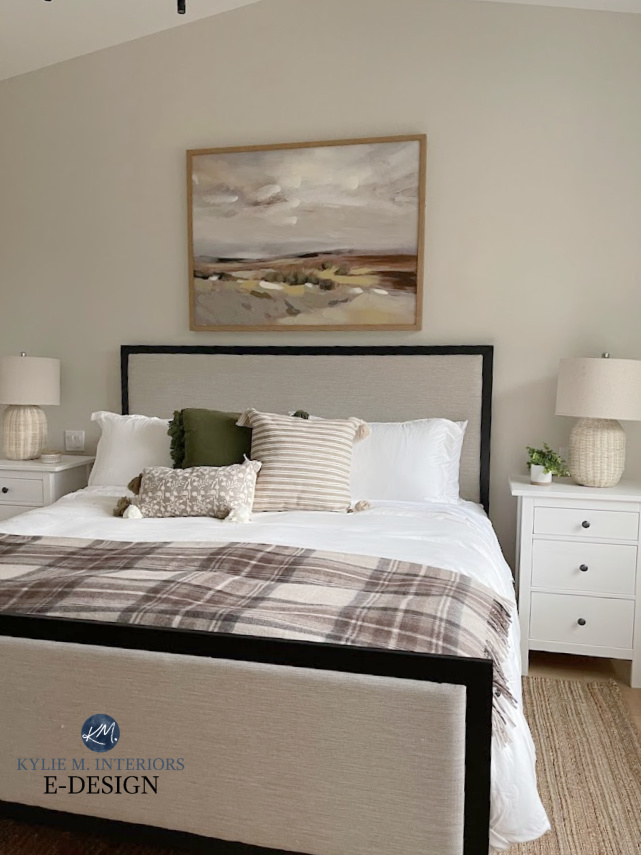
Color Review: Sherwin Williams Aesthetic White
Being a darker shade of off-white than Creamy, you’ll see the contrast between Aesthetic White and white trim or cabinets much more easily.
A SUMMARY OF OFF-WHITE PAINT COLORS
- Off-white paint colors have LRVs between 73 and 81 (approx).
- These depths offer more contrast with white trim
- Even though off-whites don’t reflect as much light as whites, they will still wash out in bright rooms.
- Off-white paint colors are great alternatives to the popular ‘white exterior paint color’. While some traditional or beachy/coastal homes suit white, many homes look better with a less stark off-white.
- Off-whites are popular for resale and as ‘whole home’ paint color options – not too dark, not too light – just right.
- Cool off-white paint colors aren’t remotely popular; only warm off-whites are. That said, if you don’t care about popularity, go ahead and fill your lil’ cool boots!
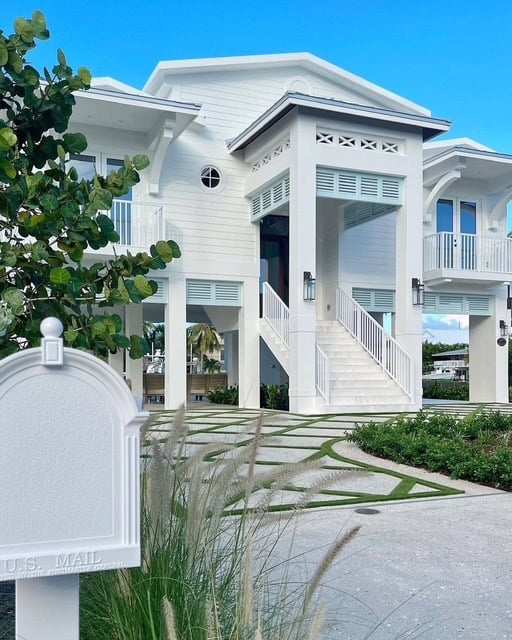
Will this home ALWAYS look good in white? You bet your cute lil’ booty it will. However, that can’t be said for the standard residential home.
The 11 Best Off-White Paint Colors
LIGHT DEPTH PAINT COLORS & LRV
APPROX. 55-72
Light-depth paint colors have an LRV (Light Reflectance Value) between 55 and 72. Many of today’s most popular paint colors sit between 60 and 74. Exactly HOW light or dark a color looks depends on how much light your room gets. For example, a room with tons of natural light could make an LRV of 65 look more like 75.

Sherwin Williams Natural Linen (LRV 66)
On the otherhand, if you have a dark room, the lack of light could make an LRV of 70 look more like 60.
Sherwin Williams Agreeable Gray has an LRV of 60; a great depth to start with if you’re unsure what you’re doing (you’ll likely want to go lighter from there rather than darker).

Sherwin Williams Agreeable Gray Color Review
TOP RIGHT: Notice how Agreeable Gray appears.
BOTTOM LEFT: Compared to the wall that gets good natural light for Agreeable Gray to reflect, this area gets less light, and the wall looks darker
Why does this matter?
You might want to adjust your LRV range to higher or lower depending on how light or dark your room is as a whole.
The light-depth range is popular and a great place to start for the average home, especially this specific LRV range.
A SUMMARY OF LIGHT-DEPTH PAINT COLORS
- Light-depth colors have LRVs between 55 and 72.
- Even though light-depth paint colors have lower LRVs (compared to whites and off-whites), they can still wash out with direct hits of natural light.
- Light paint colors show more contrast with white trim.
- In a poorly lit room, some light colors can look flat and drab and won’t come to life – lighten up, Buttercup (with light bulbs).
The next staircase is painted Benjamin Moore Collingwood, with an LRV of 62. Even with this LRV, it washes out in direct bright light…
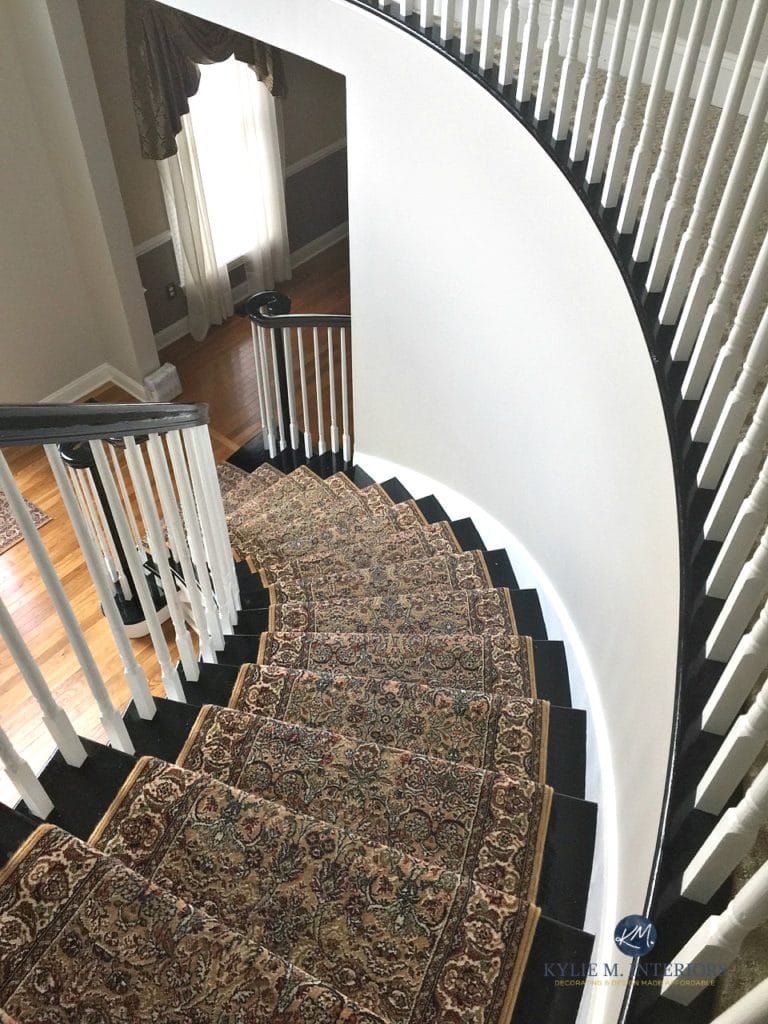
Paint Color Review: Benjamin Moore Collingwood
If you have a bright room and pair it with a lighter color (usually 55+ is where you’ll start really seeing the reflective effect), you’ll have a lot of light bouncing around, as shown in the curved part of the staircase wall above.
Why?
Not only are you giving your walls a lot of light to work with, but you’ve also chosen a paint color that reflects light, as it has a higher LRV.
Subscribe to my Kylie M YOUTUBE channel for more great Kylie M. content!
LIGHT-MEDIUM DEPTH PAINT COLORS & LRV
APPROX. 40-55
Many consultants jump from light to medium, but there’s a HUUUUGE gap in the middle of colors that don’t read as either!
As shown in the next photo, a light-medium-depth color like Sherwin Williams Anew Gray offers a nice contrast with the right white trim color.

REVIEWS: BM Stone Hearth (LRV 48) | SW Pavilion Beige (LRV 48) | SW Perfect Greige (LRV 42) | SW Versatile Gray (LRV 48) | BM Smokey Taupe (LRV 55)
Light-medium paint colors are also a great starting point when considering exterior colors.
Why?
Natural light can really wash out exterior colors, more so than in the average room. Choosing a paint color with a bit lower LRV can help it stand up to natural light a bit better (but it’ll still lighten considerably in good natural light).
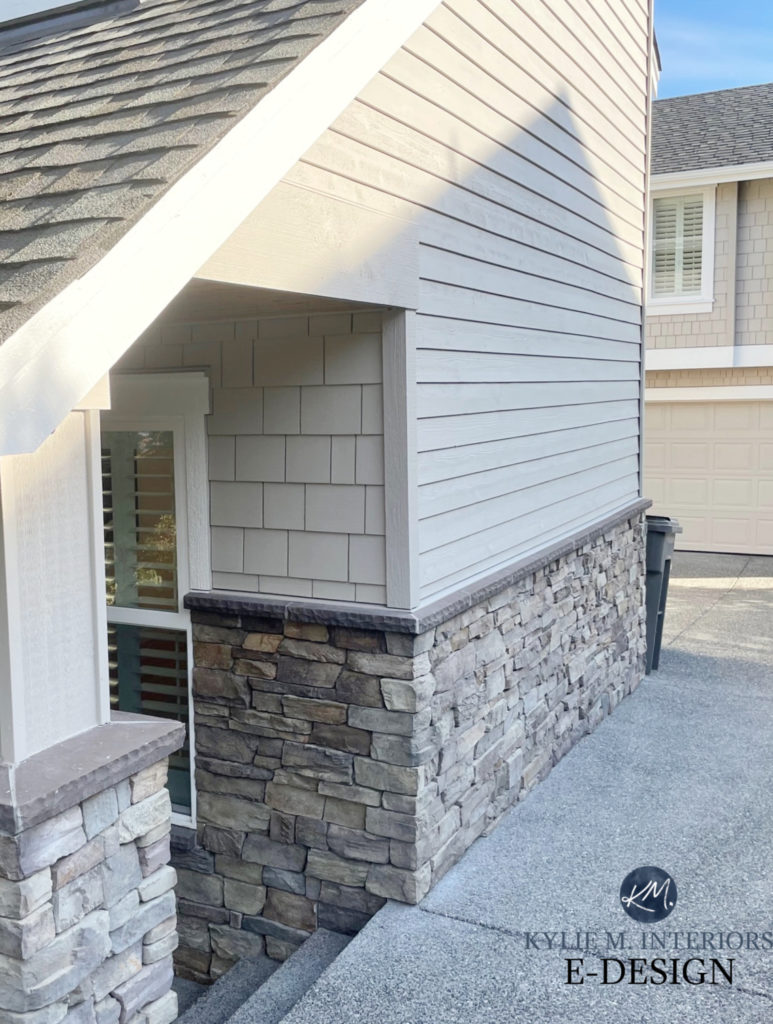
Sherwin Williams Anew Gray Color Review
Seriously, look at the difference between the lower half of the siding and the upper half.
A SUMMARY OF THE LIGHT-MEDIUM PAINT COLORS
- Light-medium paint colors have an LRV between 40 and 55.
- Paint colors in the light-medium range hold up a bit better in super bright rooms. They’ll look lighter where the light hits, but won’t wash out as much as whites, off-whites, and light-depth paint colors.
- The light-medium depth is ideal for those who want to showcase moldings or create more contrast between their walls and trim.
- This depth is reasonably common for ‘whole homes‘, but not as popular as off-white and light depths.
MEDIUM-DEPTH PAINT COLORS & LRV
APPROX. 20-40
Medium-depth paint colors have LRVs between 20 and 40. The lower the LRV, the darker the color.
Sherwin Williams Dovetail, which has an LRV of 26, is shown on this next kitchen island (LRV 26) with Agreeable Gray on the walls (LRV 60, so it’s a light color)…
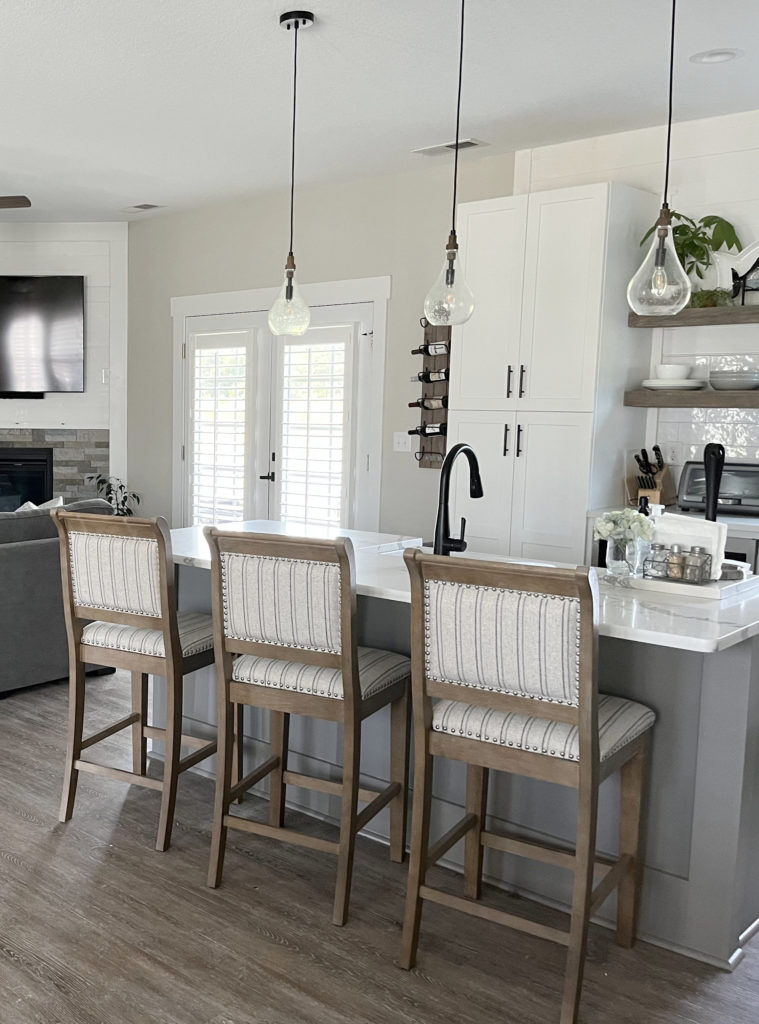
Even a medium-range paint color will lighten up when given some light to work with (as shown below). Remember, every paint color has light reflectance (even dark ones).
In this next image, notice how Sherwin Williams Foggy Day and its LRV of 20 looks lighter where the light hits and darkens down the hallway…

The LRV doesn’t change – the light you give it affects how it appears.
A SUMMARY OF MEDIUM-DEPTH PAINT COLORS
- Medium-depth colors fall within 20 to 40 (LRV, approx).
- Light-medium and medium-depth colors are great for super bright rooms. ANY paint color will look lighter when light hits it, but the darker a color is, the more it will stand up to an overly bright space.
- This range is popular for accent and feature walls and exteriors. That said, it can also look amazeballs on all the walls in a room.
- Paint colors with medium-range LRVs reflect a moderate amount of light, especially in the middle of the range.
- In a poorly lit room, medium-range neutral paint colors can look flat and drab.
- In a room with poor lighting, paint colors in the medium range will take ANY light they can and reflect it into the space, but don’t expect any screamin’ glory. If you don’t want to choose a lighter color, consider a paint color with more color/vibrancy/less neutral to help counteract the shade vs. going with a more standard neutral paint color.
This next room is painted with Sherwin Williams Retreat, which has an LRV of 21. This puts it between the medium and medium-dark range. If you like colors in this range, you might look for colors with LRVs between, say, 15 and 25 – you don’t have to stay in one set range.
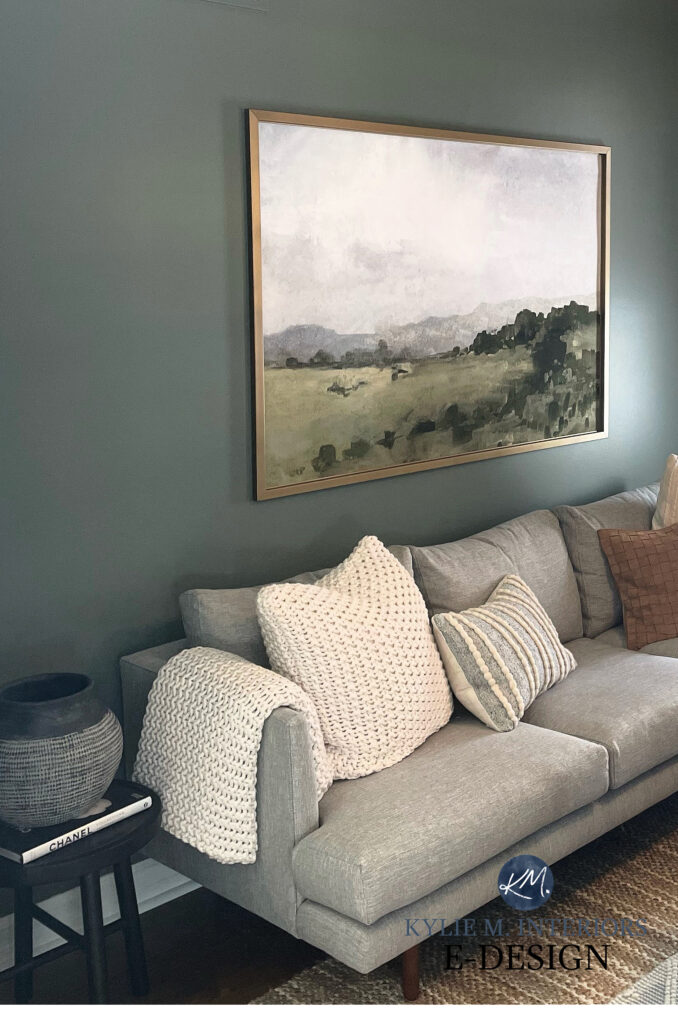
Sherwin Williams Retreat Color Review
MEDIUM-DARK PAINT COLORS & LRV
APPROX 10-20
Just as with light-medium depth paint colors, medium-dark paint colors are the ‘happy mediums’—literally, between the medium-depths and the dark range.
Sherwin Williams Gauntlet Gray (LRV 17) is popular medium-dark, warm gray paint color…

And yes, the art still needs to be hung – I’m sure it is by now.
Benjamin Moore Amherst Gray (shown below with one of the best warm white paint colors on the cabinets) is a medium-dark gray.
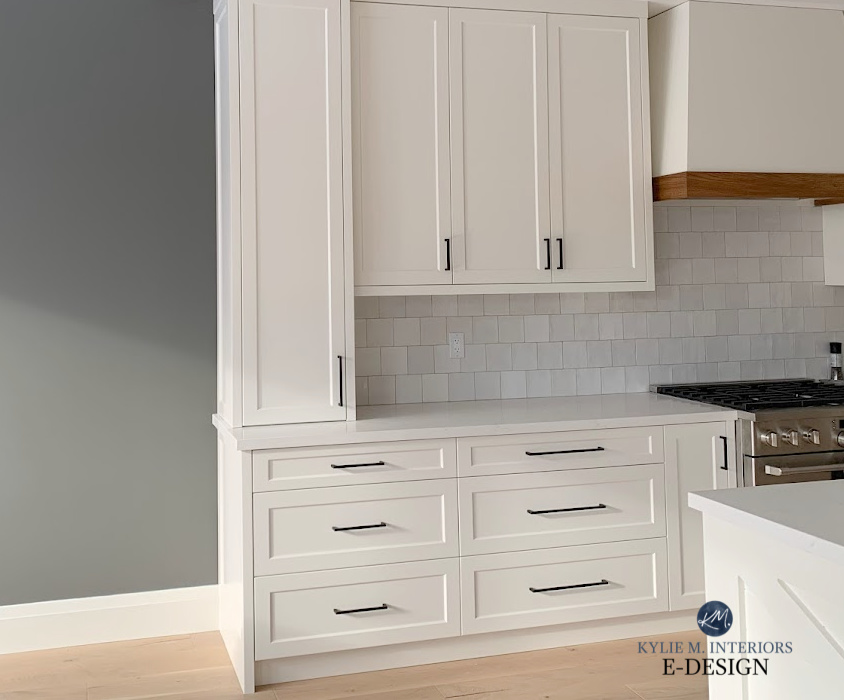
Notice how Amherst Gray appears darker at the top of the wall, but brightens where the light hits.
Why?
Although its LRV is lower, it still reflects some light. Even a color with a lower LRV reflects SOME light. In reflecting this light, it looks lighter than it does in an area with less light.
Remember, dark paint colors reflect light too!
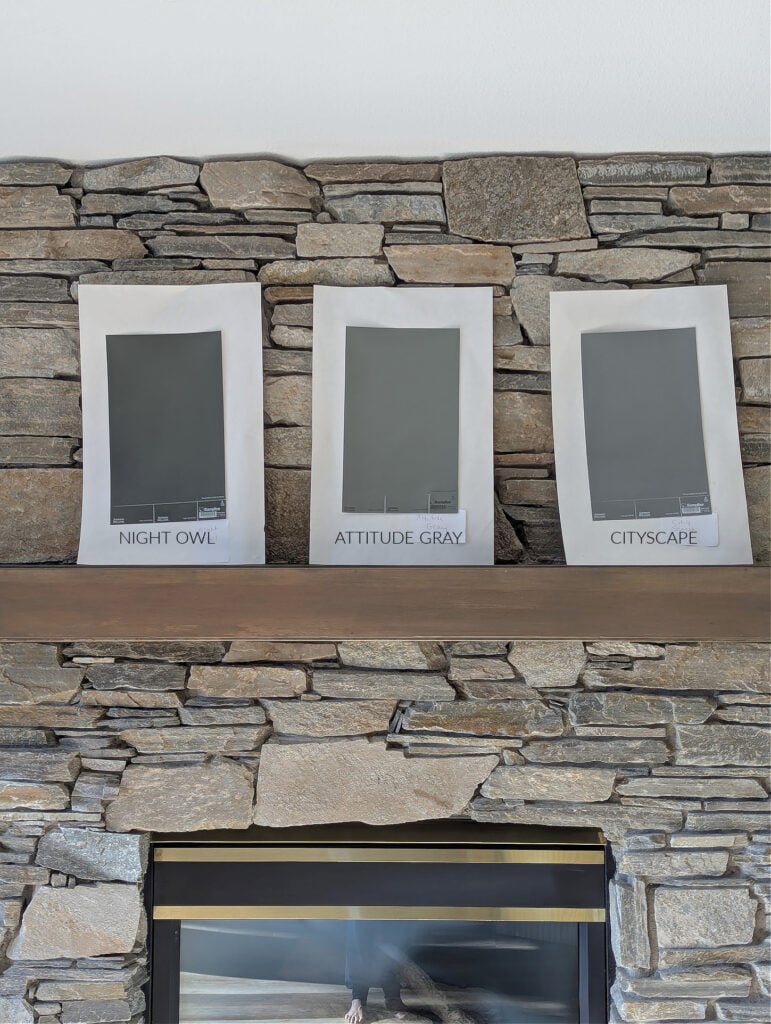
SW Night Owl (13) | SW Attitude Gray (20) | SW Cityscape (22)
Check out the above samples. Notice how Night Owl, with its LRV of 13, is visibly darker than the medium-depths of Attitude Gray (20) and Cityscape (22), though they definitely wink at the medium-dark range – they’re skookum.
A SUMMARY OF MEDIUM-DARK PAINT COLORS
- The medium-dark range runs from approx. 10-20 (LRV)
- Medium-depth colors don’t have the (sometimes intimidating) depth of traditional DARK paint colors.
- These darker shades are super popular on feature and accent walls.
- Medium-darks are also found on kitchen cabinets, but are far more popular on painted kitchen islands.
- Exteriors can look amazing in medium-dark shades, as many of the top shades complement the brick and stonework, as well as contrasting well with white trim.
- Exteriors with black windows are commonly painted medium-dark paint colors.
Benjamin Moore’s Best DARK Gray & Charcoal Paint Colors
DARK PAINT COLORS & LRV
APPROX 2-10
These are the heavy hitters. While not all of these are black, once you get under 6, be ready for a wickedly dark color.
Sherwin Williams Cyberspace (below) is wickedly gorgeous with its LRV of 6. In a well-lit space, this color can look stunning, lighter, and more colorful.
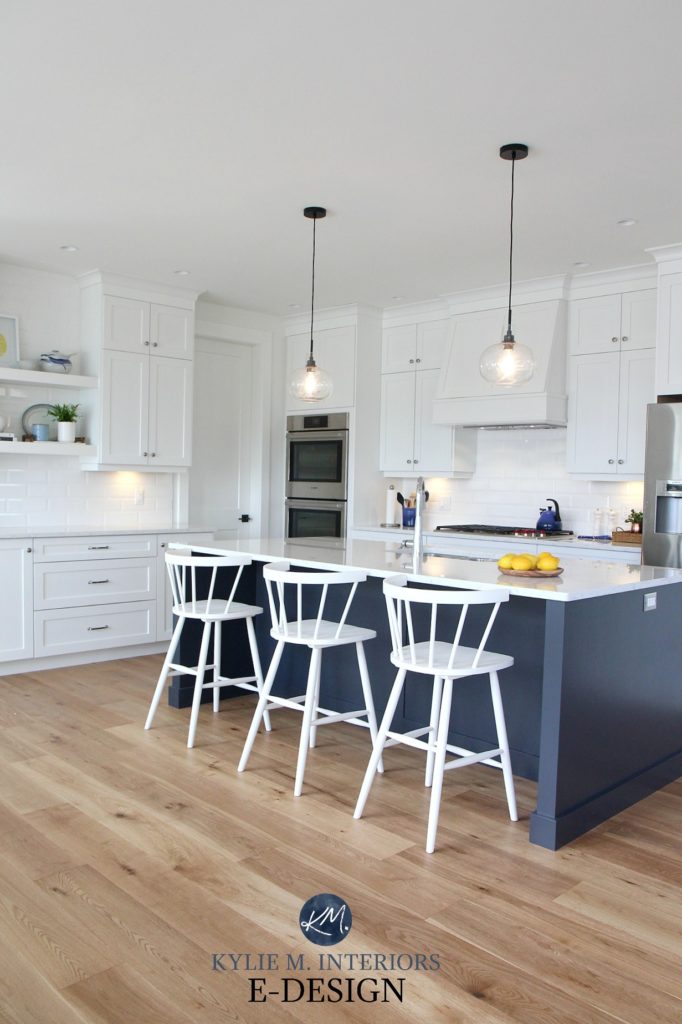
However, in a dark room, it can appear closer to black and lose some of its color/hue.
In fact, dark colors can almost look blackish in poorly lit rooms.
This next room shows Cyberspace again. Notice how it changes color and depth from left to right, depending on the amount of light it receives…
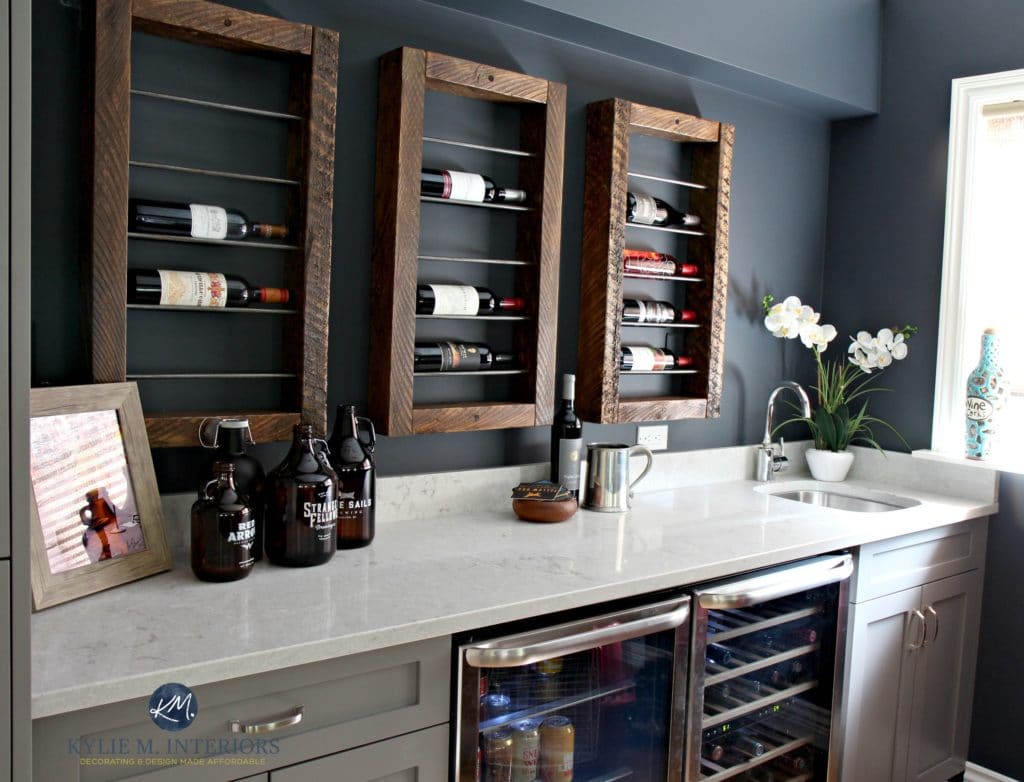
Compare the wall space on the far left with that on the far right. No light = no reflective value.
As for black, one of my favorite shades is soft black called Iron Ore, coming in hot with an LRV of 6. Check it out at the end of this kitchen island…
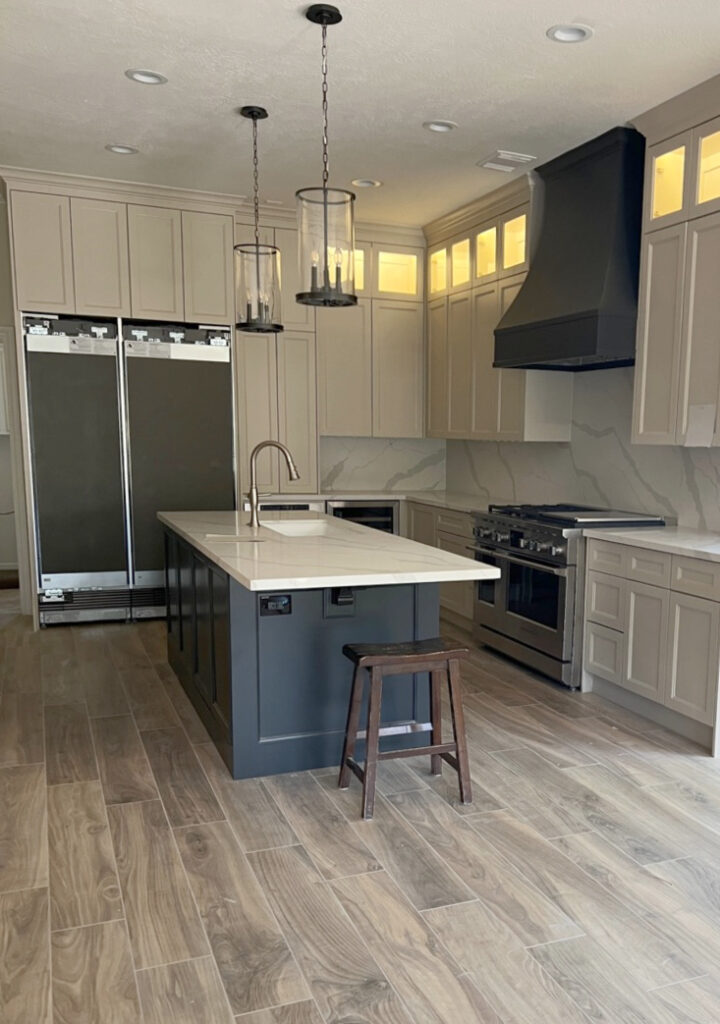
Compare the end of the island to the range hood: the island gets light and reflects it; the range hood doesn’t.
Cool, eh?
Here’s Iron Ore looking badass and beautiful again…

- The left side of the built-in cabinets gets direct light, making Iron Ore look lighter.
- The right side gets minimal light, making Iron Ore look more ‘black’ than soft black.
Now, let’s go big or go home with Sherwin Williams Tricorn Black, and it’s wickedly low LRV of 3…
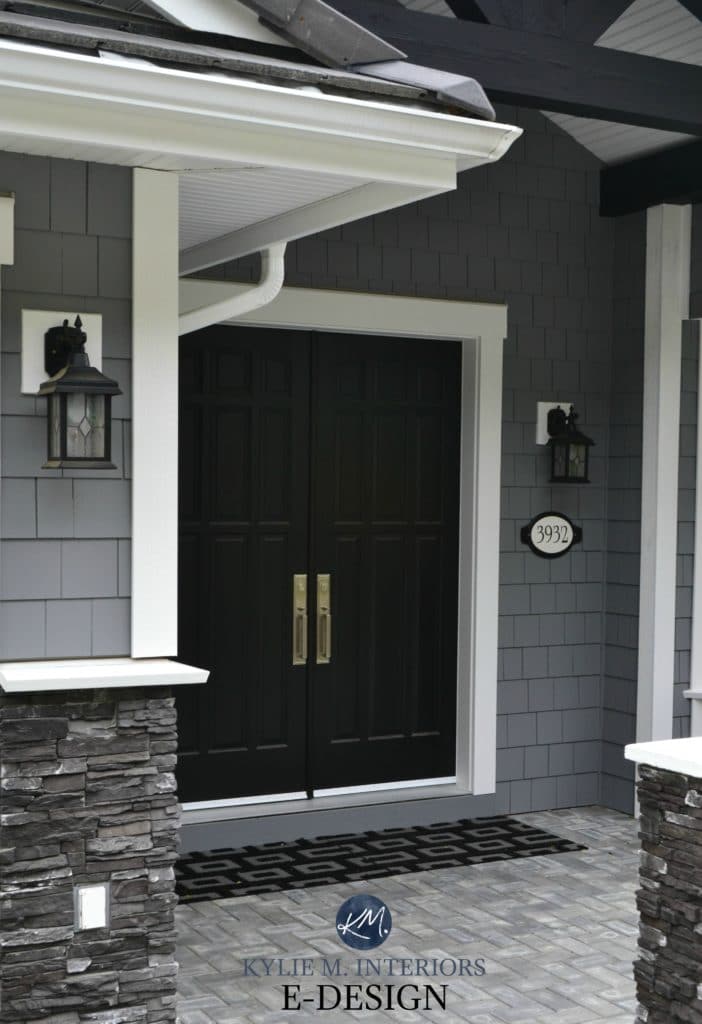
The Best Black Front Door Paint Colors
A SUMMARY OF DARK PAINT COLORS
- Paint colors with a lower LRV will reflect some light, but not tons. If a color’s LRV is 10, it will absorb a lot of light and reflect a smaller amount. If you want a dark color to look lighter, GIVE IT LIGHT!
- IN A DARK ROOM, a dark color won’t come to life and won’t reflect light (as it hasn’t been given any, and it has a low LRV to boot, double-whammy).
- Dark paint colors are super popular on accent walls.
- While some paint their kitchen cabinets a dark color, they’re far more popular on painted kitchen islands.
- The inside of your front doors can look striking in a well-chosen dark paint color, as can the outside of your door.
- While exteriors can be painted dark colors, remember that they absorb more light and can fade a lot faster.
Now, let’s consider some examples…
EXAMPLE 1: YOU HAVE A DARK ROOM
If you have a dark room and want it to look lighter and brighter, you might choose a paint color with a higher LRV, as it’ll reflect more light.
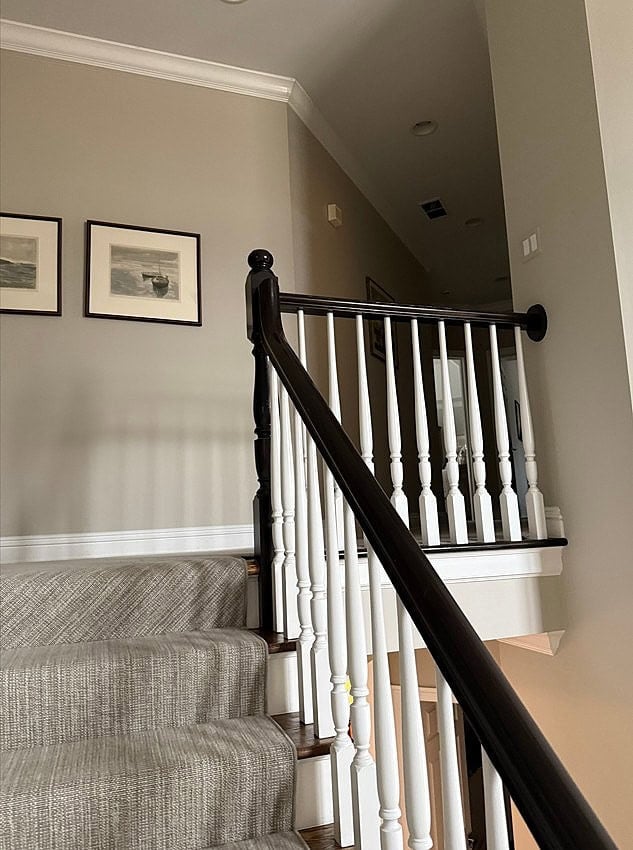
Look at how light this color looks beneath that upper stair railing.
Now, it can’t reflect what you don’t GIVE it, but it will take whatever it’s given and reflect it. On the other hand, a darker paint color won’t reflect as much – combine that with minimal light, and you’ve got one damn dark room.
- For a dark room, you might consider colors with LRVs of 72 or higher.
- From there, figure out how much COLOR you want on your walls, since 72+ only means it’s a lighter color, in general.
- Dark rooms often benefit from higher LRV colors with a bit more ‘color’ or ‘chroma’. Muted, dirty neutrals don’t do as well, regardless of their LRV.
That said, many people prefer a dark, moody color for their dark room like Sherwin Williams Urbane Bronze (below). Remember, it’s your home – you do you, boo…
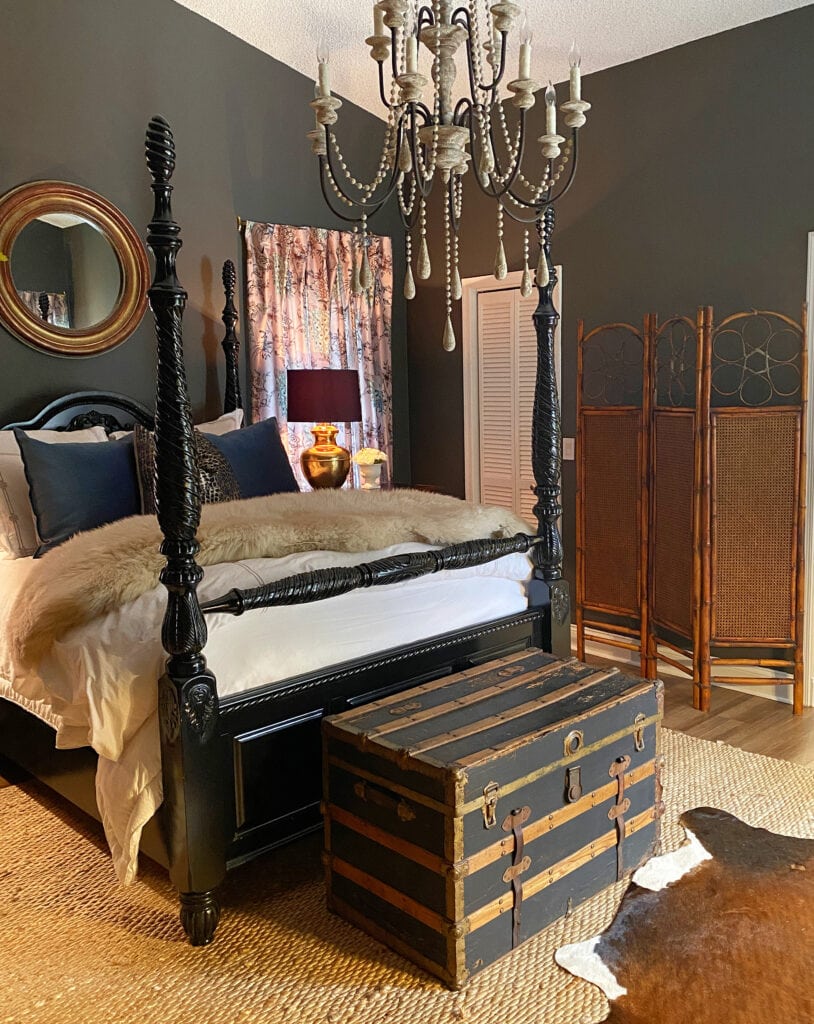
EXAMPLE 2: YOU HAVE A SUPER BRIGHT ROOM
A super bright room has a lot of light to give. If you paint your walls a high-LRV color, you’re compounding this room’s already bright look.
Consider these next samples (I’m rounding up their LRVs for everyone’s sanity)…
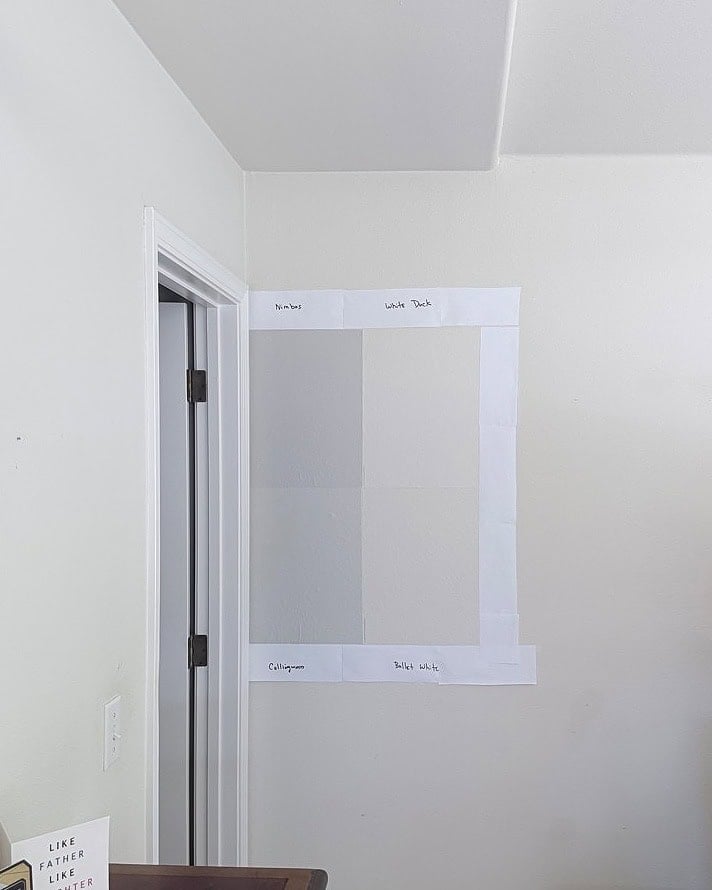
- LEFT SIDE TOP: Benjamin Moore Nimbus (LRV 60)
- LEFT SIDE BOTTOM: Benjamin Moore Collingwood (LRV 62)
These 2 colors are in the ‘light range’ of LRVs (55-71).
- RIGHT SIDE TOP: Sherwin Williams White Duck (LRV 74)
- RIGHT SIDE BOTTOM: Benjamin Moore Ballet White (LRV 72)
These 2 colors are in the ‘off-white range’ of LRVs (72-81).
If you have a bright room, which of the 4 will reflect less light, potentially creating a more ‘calming’ look? Benjamin Moore Nimbus and Collingwood.
That said, some people want bright on bright, so long as you’re prepared for it and know how your paint color could appear (or not – it could wash out a lot).
- When choosing colors for a bright room, many look at colors in the light range (55-71) and the light-medium range (40-54). Light to light-medium colors reflect a good amount of light, without going as far as the off-white and white range. They can help calm a bright room while still keeping things…well, bright.
- Of course, you can look at darker colors with lower LRVS, but the light-to-light-medium range is the most popular.
- From there, you get to decide how much COLOR you want on your walls, or whether you prefer the wild world of neutrals.
FREQUENTLY ASKED QUESTIONS
LRV isn’t an easy idea to wrap the ‘ole noggin’ around, and you probably have questions. If I don’t answer them below or in this other LRV blog post – leave a comment!
WHAT’S THE BEST LRV FOR A DARK ROOM?
Choosing a light paint color may be better for a dark room if you want to brighten it, but it won’t save the day—you need actual light for the paint color to play off and reflect.
One way to add brightness to a dark room, along with LRV, is to choose a color with more chroma/color vs. a more standard neutral paint color (and improve your lighting).
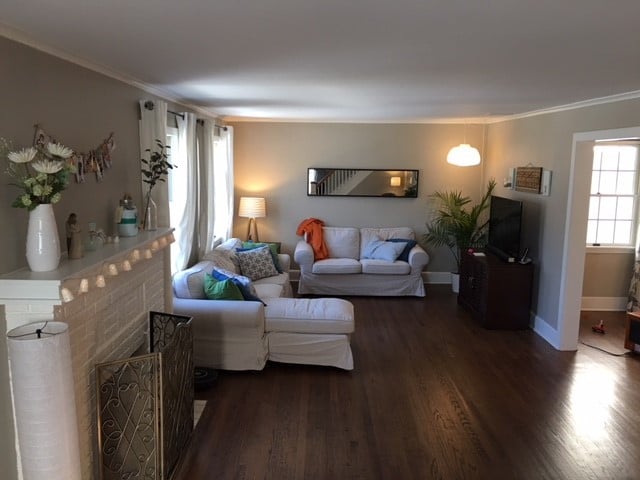
The next photo shows a room painted in one of the most timeless, neutral paint colors: Benjamin Moore Revere Pewter. Notice there isn’t much light, which affects how Revere Pewter looks—its LRV of 55 isn’t being used effectively.
In this next photo, the bedroom is painted in Revere Pewter (not the bathroom)…

- The above bedroom has a good amount of natural light on the left side, making Revere Pewter look just right (the bathroom is Wickham Gray). Its LRV of 55 looks great in this light.
- On the right side of the photo (outside the bathroom entrance), there’s less natural light, and Revere Pewter looks darker.
This example shows how a neutral that appears perfect in a well-lit space can look drab and dingy in a low-light room, even with a moderate LRV of 55.51.
We need to lighten up, Buttercup!
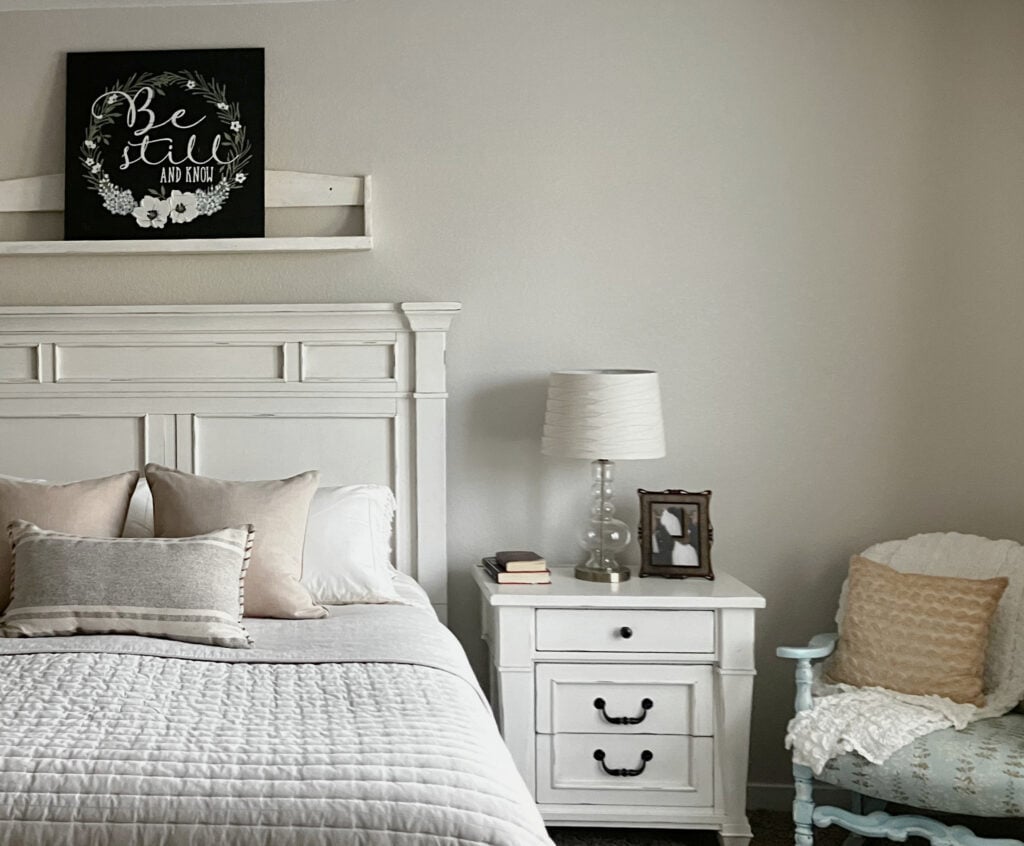
Here’s Sherwin Williams Egret White (LRV 70) looking balanced and beautiful in this room.
And to answer your question about the best LRV for a darker room…
- Generally speaking, paint colors with an LRV of 74 or higher.
- Consider how much gray vs how much color your chosen shade has. Even a high-LRV color with a decent gray or beige base can look dingy. Consider a bit more ‘color’ vs less.
WILL NATURAL LIGHT/MY ROOM’S EXPOSURE CHANGE MY PAINT COLOR’S LRV?
Natural light won’t affect your paint color’s LRV; it is what it is. However, the more light you give a color, the more light it will reflect, especially if it has a higher LRV.
In other words, your paint color’s LRV will never change; it’s static. However, how it APPEARS depends on how much light it’s given.
This dining room (below) is painted Sherwin Williams North Star, which has an LRV of 62. Because the room has a lot of natural light, North Star looks a bit brighter than expected; however…

The Best Creamy White & Off-White Paint Colors
What’s cool is that the walls in the staircase are painted Sherwin-Williams Pearly White (LRV of 77). Because the staircase doesn’t get as much natural light, the walls look darker than the dining room, even though Pearly White’s LRV is considerably higher!
Colors with higher LRVs reflect MORE light; colors with lower LRVs reflect LESS light. But if you don’t GIVE them light, it won’t matter.
So, even if you pick a light color with a high LRV, if you don’t give it light to reflect, it won’t rise to the occasion, which goes back to one of my favorite sayings (I have about 80)…
No paint color will save you if you don’t have enough natural or artificial light. And yes, I make this font big because it matters (I also talk in big font when explaining things in person).
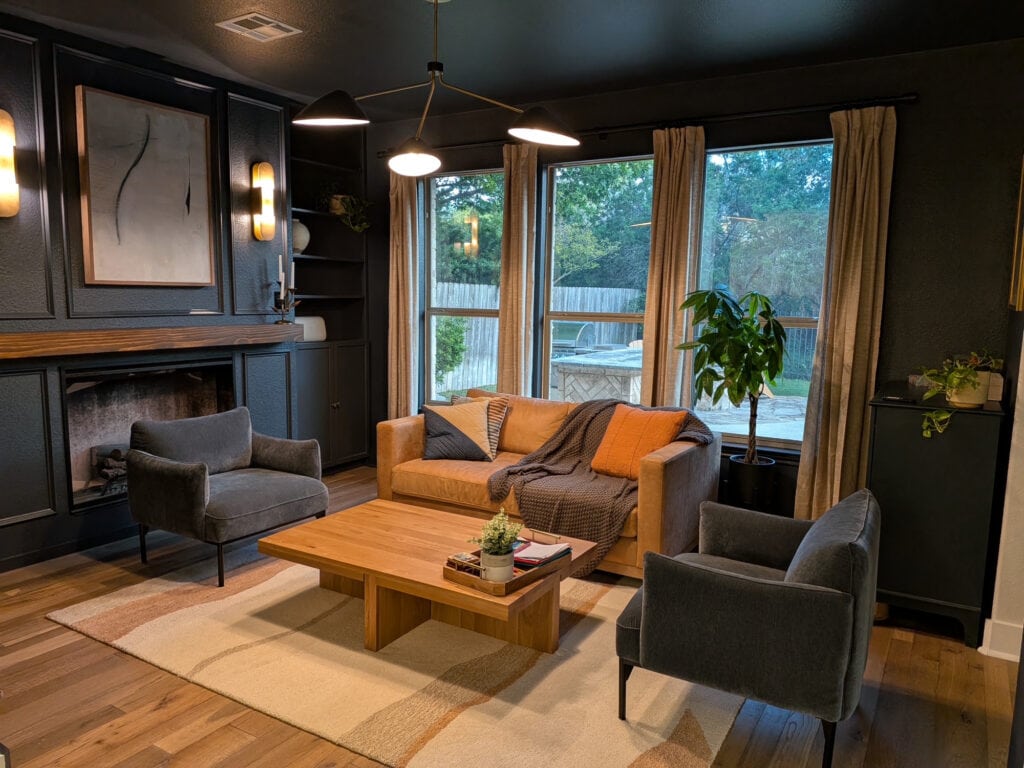
But, of course, there are those (like myself) who aren’t afraid of a dark color in a dark space – in which case, fill yer lil’ moody boots.
WHEN YOU LIGHTEN OR DARKEN A PAINT COLOR, DOES ITS LRV CHANGE?
HECK YES, it does. Any change you make to a paint color alters its DNA, and the LRV will increase or decrease depending on the extent of the change.

Read more right here… LRV, Paint Colors & YOU.
When you lighten or darken a color, you’re creating a new color. While it might have similar roots, its DNA has changed. MOST times, you get a ‘lighter version of what you started with,’ but sometimes, the undertones and temperature change more noticeably – it depends on which tints were used to make the original color.
I have several lightened and darkened paint colors in my home. I’m a big fan of tweaking colors to get the look I want.
WHAT’S A GOOD, IDEAL LRV?
Here are some basic guidelines to consider. Keep in mind that these are just starting points. If you want a different look, it might be outside of these ranges.
- THE AVERAGE SINGLE ROOM: LRV 62-75
- FOR EVERY ROOM IN AN ENTIRE HOME (PAINTED 1 COLOR): 65-75
- KITCHEN CABINETS: LRV 82-94 (or 45 and lower)
- FEATURE WALL: ANYWHERE FROM 2 (black) to 50, BUT 30 IS A GOOD AVERAGE
- EXTERIOR: 35-60, but really, it runs the full gamut…whatever a gamut is.
- FRONT DOOR: APPROX. LRV 10 – 20
Again, the above numbers can vary; these are just good baselines for your color journey.
In this home bar, my client wanted a moody atmosphere, as she called it her ‘bat cave’. But at the same time, we didn’t want it to look too heavy…

We settled on Sherwin Williams Still Water LRV 10 as the perfect dark blue-green blend. Also, notice how much I love it when my clients know my personal tastes, if you know what I’m sayin’…
On the other hand, this next hallway has a range of light, from no natural light to an adequate amount…

Paint Color Review of Sherwin Williams Antique White
For this home, I recommended Sherwin Williams Antique White (LRV 72) to add warmth and interest in the dark areas without making the lighter areas too yellow or overwhelming.
WHAT’S CONSIDERED A HIGH LRV?
The higher the LRV number, the lighter the paint color. Paint colors with LRVs of 74+ (off-white and white paint colors) are considered HIGH LRVs.
The Best Light Paint Colors for a Darker Room
SUMMARY OF LRV & PAINT COLORS
- LRV stands for Light Reflectance Value and refers to how much visible light a paint color (or surface) reflects.
- You can use LRV ranges to help choose paint colors. LRV can be broken up into depths including white, off-white, light, light-medium, medium, medium-dark, and dark/black.
- Generally speaking, dark rooms do well with higher LRV colors (however, there are other factors like choosing a ‘color’ over a neutral and improving interior lighting).
- Light rooms combined with a high LRV paint color can make for a VERY bright space. This is why many exteriors look too stark painted white.
So there you have it – LRV in a big, fat nutshell.
PARTNER POSTS…
How to Choose Paint Colors for Any Room
Create a Cabinet & Wall Color Palette Using LRV
Learn More About the Kylie M Color System
Get the best paint color advice with Kylie M’s Online Color Consulting Services!

Updated with fresh, new content and images for 2026


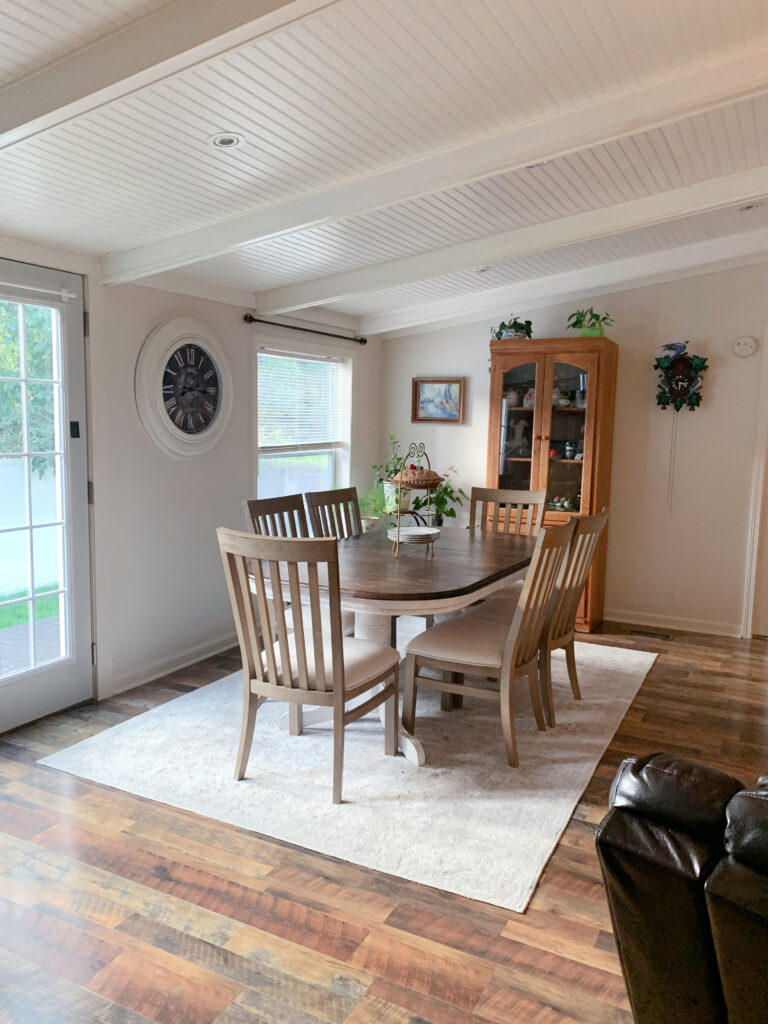

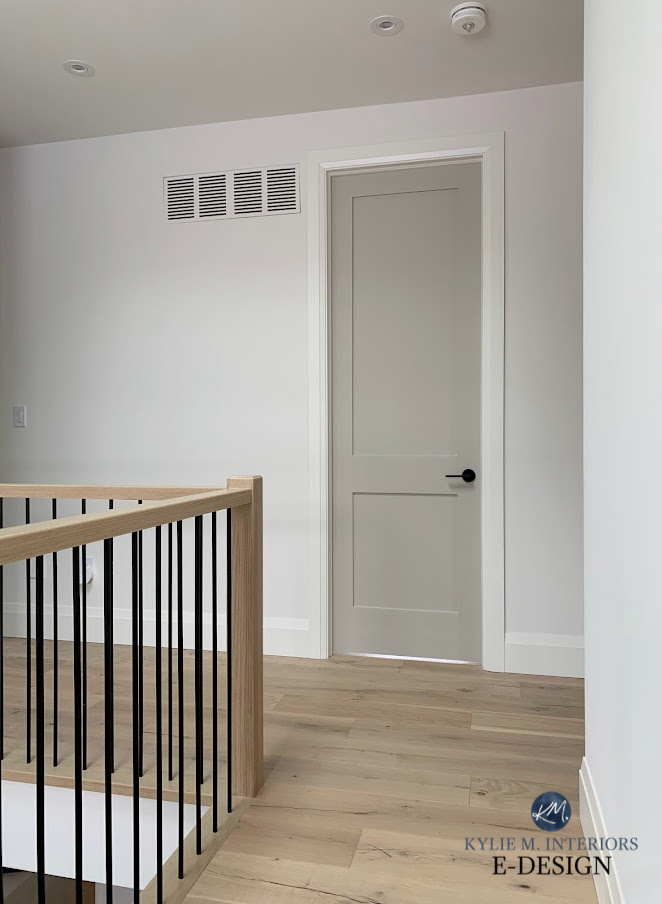
So, kind of a side question that I thought LRV might address, but doesn’t (now that I’ve read your article)…So, LRV addresses the differences between lights and darks. What is the technical difference between a neutral (with a color undertone) and a color with a (gray or whatever undertone)?
Oh Greer, I LOVE YOU – no one has ever asked that before! I’m actually writing a course right now and talk about this exact topic in it. The short story is that there IS no definitive line and is VERY OPEN to perception, which is why it’s SO HARD! For example, a lot of people look at a colour like BM Puritan Gray and see it as ‘gray with undertones’, but I’ve had clients find it not gray enough and see too much blue-green. For me, it’s about what’s the OVERTONE or MASS COLOUR – the one you automatically see first when you look at the walls. Again, open to perception, but if you just SEE BLUE, then it’s probably too colourful for you. However, if it could easily pass as gray, then you might be closer to the ‘gray with undertones range’.
Does that help AT ALL???? Any thoughts you have just holler as it just makes me think harder!
Hi Kylie. I’m trying to choose between BM Balboa Mist (LRV 67) and Collingwood (LRV 62). How much of a difference will 5 points make in a 2 story foyer where the 2nd story does not have a lot of natural light?
Well, you will notice a shift between the two! For a LOWER light area, I would lean towards Balboa because it is that bit lighter and softer :).
What color is on the cabinet in the Classic Gray picture? Thank you, Kate
Hi Kate, that’s Benjamin Moore MEtropolis 🙂
Do you have a blog that lists the Benjamin Moore colors with a LRV of your magic number “62”? Or a list of colors within the magic range?
Ooooo, say no, that’s a GREAT idea!
Off the top, BM Collingwood, SW Big Chill, SW On the Rocks, SW Agreeable Gray – just a few to get you started!
Kylie! My friend, it’s been a long time! I have to say, this article is everything. Explaining LRV is nearly impossible….honestly, after decades in the business, I still haven’t wrapped my brain around it, but this is THE ARTICLE to start that brain-wrapping process. I love your writing style and LITERALLY laughed out loud at “glug glug glug … I mean, sip sip sip”. You are the best of the best!!
JENNY, this is such an awesome comment – THANK YOU! Yes, I know LRV is kind of MIND-boggling, but it’s like once you get it, you never look at paint colours the same AGAIN! And I’m glad you think I’m funny, I tell my husband and kids that I’m funny all the time and they’re like ‘ermmm, no’.
Hey Kylie! So glad i stumbled on your post what PERFECT timing OMG! I have a new build i just moved into with very low grade, stark white awful paint that does nothing for my house and honestly it’s so ugly it might just be primer🫤. It’s dreadful and not full of life. Though i personaly love the white walls i have been SO torn between Chantilly Lace & Simply white to repaint it. Is there one you prefer more? I would like to keep the white but the white they used is all wrong and makes it feel very stale vs cozy plus i have kids so i want nice, cozy feel that would bring out that beachy look we desire with all our wood tones. “Most” rooms get natural light throughout the day as the sun changes so i am really stuck on which color would make it feel like home vs a builder grade home.
Also….i am planning on painting the exterior of my house white as i love the beach cottage looks there too but i am wondering if the LRV matters on the exterior like it does the interior? Can you tell me if this rule still applies.
I was looking at either Pure White or Snowbound (this will be going over a taupe color house) but after reading your post i am not sure if the LRV matters for outdoors also so it’s not blinding vs beautiful. I have a South facing home and would love a little help before i make a HUGE expensive mistake. Help please! Thank you so much 😊
Hey Shawna, I can’t answer ALL of your questions, but Chantilly ‘can’ be a bit ‘white white’ and Simply White can come up a touch yellow – both have their place, but when I’m looking at a WHOLE HOME white, it’s often SW Pure White that comes up as it often suits more interior hard finishes (ie. countertop).
As for the exterior, whites tend to look that BIT whiter, depending on how MUCH light you get, but generally – they’re pretty white. A lot of my clients are shifting to a slightly softer look, like BM White Dove (even Pure White is a bit soft too, creating a nice look). It really all depends on the AMOUNT of light you get as even an off-white could look QUITE BRIGHT!
Hi Kylie,
I just bought my first home and stumbled across your blog while researching white paint options. I’ve been doing a deep dive in to your posts and it’s been so helpful. I would love know what the paint colors are from the thumbnail image on this post.
Also do you have any posts about coordinating paints colors with exotic hardwood floors?
Thank you,
Jennifer
Hello Kylie, this article on LRV is fantastic!! I have been a painting contractor for 40 years. I study paint. It’s composition, what the included different ingredients do & how they react to each other. I am just starting to study LRVs and SRI (solar reflective Index) and you have done LRVs very thoroughly and explained it in layman’s terms (maybe the sip,🍷 sip,🍷 gulp 🍾helped in your writing ✍️.)
Thank you for your time & work!
Jeff, thank you so much for this! I’m SO not scientifically-minded, yet SUPER passionate about paint – THANK YOU!
Hi Kylie! I’m experiencing the vast array of whites for the first time! Yikes! I had kitchen cabinets painted in Benjamin Moore “Calm-OC22” LRV of 77. Thinking of selecting another white on the walls throughout the living room, dining area and kitchen. I’m in a small condo, southern exposure, with very little light. I have a medium brown maple floor & painted baseboards in Calm. I love the serenity and elegance of taupe. Don’t know what direction to go in, if you can offer a tip. Thank you very much. I learn a lot from you! — Jean
Hi Jean! Calm is actually an off-white with a reasonable viole tundertone, which can make it tricky! Sometimes the best thing to do is the same color on the walls/trims, I would GREATLY HESITATE to go outside of that. I suppose you could look at BM Chantilly lace for the walls, but it coudl enhance the violet in Calm :).
The last several times I have looked at your site for advice, I could not take in the content because there are such large banner ads – top and bottom – that there is little screen left for content. Add the constant moving from ads makes it impossible to concentrate. I will be leaving now. Sorry this is so.
Hey Deb, I appreciate your comments! It’s a tough line to follow as I can’t write for free. Ads are how I support my family and without them, I can’t write. I try to find a happy medium for myself and for the FREE content that I offer readers :). Back in the day you’d have to buy a book or a magazine – or hire a designer for hundreds of dollars!
What a wonderful article – FYI Encycolorpedia gives the LRV of paints which will save hunting fan decks and calling customer service. Our Southern African paint stores haven’t started including LRV anywhere but this has helped me find it.
What would you say is a good “gap” in LRV between a house colour and trim? We are putting a light putty colour on the main body of the house (LRV 65) and are looking at coloured trim to go with it. A color with a similar depth looks like it could not offer enough contrast as it will differ in tone but not depth. What are your thoughts on the pairings?
Thank you.
Hey Tessa, I love Encycolorpedia too, it’s super helpful! As for gap in LRV for exteriors, for the average application, based on the house being 65, I’d love to see approx. 15 points (or more). However, if you’re looking for a more subtle tone-on-tone look, 10 points would be the start 🙂
Hi Kylie,
Thank you for this article, it’s nice to see the grouping and it explains why I’ve been struggling so much to get a colour combo. I’m trying to do a contrasting board and batten wall in “off whites” in my little bathroom. I laughed when I read this article I realized that off white is pretty darn relative and that’s why I’m failing miserably. The room has very little natural light but lots of artificial light that’s unfortunately giving a red cast to grieges. Can you tell me how much difference you need between lrv to create a noticeable but not strong contrast.
Well, it can depend on the exact color combo, but I’d say 10 is a place to START. For example, if I started with something like SW Aesthetic White, which is an off-white, I might look at Pure White for a noticeable, but not remotely shocking shift. Aesthetic White is 73, Pure White 84. Also, have you tried changing your bulb’s Kelvins to get a better read on things?
Another thing to try is to find a color that’s around 70-75. Get samples made 50% lighter and 75% lighter and see which contrast you like the most (knowing they’ll still be relatively subtle). Now you need to be careful as undertones DO shift around – some colors work like a dream, some change too much with this. I’ve had a lot of success!
Closets? Not walk in. I’m assuming a higher LRV but deciding on closet paint color. Of course white but 75 whites later it’s confusing. Undertones I’m picking what will go with my color scheme. Now I don’t want a color that alters all other colors.of clothes messing up choosing colors.
I would pick BM Pearl River next Ice Cube Silver, Ice Fog or go safe with White Dove.
Why do your examples all fall pretty much on the grey spectrum. There are some nice warm colours and it would be nice if you would use both warm and cool options for the LRV. I’m so over grey on everything
As usual, the more words in an article like this, the less usable information. Also, it is disrespectful to assume my time has no value.
Oh and o believe you mentioned up front that you were drunk while writing this?
Oh Phil, you sound like a bundle of fun. If you can’t take a joke and don’t like reading, you might want to find another blog to read.
Hi Kylie,
Thank you for your posts, they’re so helpful!
I recently had my entire home painted SW eider white.- new construction.
The color pulled a lot of pink and purple, and made my hardwood floors look really pink! Tried changing between 4 different kelvin’s but artificial light made it worse.
I’m trying to find a clean white for them to repaint a monochromatic ceiling/walls/trim/doors color that won’t make my floors pull the pink or that has noticeable pastel undertones on the walls but I also have a black stained kitchen and a lot of northern & south/ western natural light. Would pure white sw help neutralize my floors or will the higher LRV reflect that to my walls? Will pure white and black stained kitchen be too much contrast?
The floors looked a great neutral white oak in the house when it was primed although they do have a pinkish hue but the Eider made everything intense pastel!
Thank you!
Kristi
Hello! This was extremely helpful. I’m having the most difficult time picking a paint color for my kitchen. My house was built in 1992 so I have the cherry/honey oak everywhere (flooring, cabinets, trim, etc). I recently took down an above-the-island decoration and it changed the lighting completely in here, so now my walls look green because we have very minimal natural light. I’m trying to find a warm, light color that will mute the orange in the wood, without painting the cabinets or the trim. Can you suggest a color?
Hey Tanya, you’ll find some great colors in here! https://www.kylieminteriors.ca/how-to-update-golden-or-honey-oak-cabinets/
Hi Kylie, thank you so much for your LRV info. So very helpful! I just moved into a condo with SE exposure. Now seeing it in morning light the main living area is actually BM Serpentine Green which I love by the primary is that horrible baby puke khaki that so many men choose with an Iron Ore accent wall. I am trying to choose a high LRV blue to brighten up the primary and get rid of the puke. Any suggestions? I was leaning toward BM Pale Smoke (63.6), Healing Aloe (68.25) or Quiet Moments (60.73). Help!!
Ooooo, Iron Ore isn’t as happy with blue tones and really loves colors NEUTRALS that lean slightly violet or green! This is because Iron Ore has a wee green undertone – violet slightly accents it, but green goes ‘with it’ (warm green, not cool green).
What an educational post! Thank you. I have a small nook off the living room that I use as a small reading room. It has very little natural light and nothing direct. I want a cozy feeling so I was thinking of a dark color. I have SW Soft Sage in the living room and was thinking of using Endless Sea or Urbane Bronze or a dark taupish-brown. Maybe even Spiced Cider. Any suggestions? Scared that I’m leaning too dark. I want cozy but not too heavy.
Hi, Kylie. I appreciate your information and the depth! I’ve read about wall colors with cream cabinets, directions of the exposure of the windows, and LRV. I have cream colored cabinets (maybe Casa Blanca or BM Navajo White) and North facing windows. I have an open concept house and I don’t want to paint it all dark because of the kitchen cabinets. Would it look good if I paint my walls the same color as my cabinets (and what if I don’t get the match right?)? Are BM Navajo White and Casa Blanca acceptable as wall colors? Would it be considered normal to paint my kitchen one color and the rest of my house a different color? What if I paint my whole house the color of the crown molding which is a slight off white? Does any kind of white look okay with cream cabinets? Will it make them look very yellow? My walls are currently SW Sandbar. They need to be repainted because they won’t clean. The color does seem to go well with the house, but it’s rather dull and a little too heavy to ignore. I appreciate your advice.
Ooo boy, this is a lot of questions! Generally speaking, if you don’t want to go dark, your best bet is to match your cabinets as CLOSELY as possible :).
Thx. I will see if the paint stores can help me with a match